Wednesday, April 30

Photo by GaborfromHungary, morguefile.com
Thoughts in a Zoo
By Countee Cullen (1903-1946)

They in their cruel traps, and we in ours,
Survey each other’s rage, and pass the hours
Commiserating each the other’s woe,
To mitigate his own pain’s fiery glow.
Man could but little proffer in exchange
Save that his cages have a larger range.
That lion with his lordly, untamed heart
Has in some man his human counterpart,
Some lofty soul in dreams and visions wrapped,
But in the stifling flesh securely trapped.
Gaunt eagle whose raw pinions stain the bars
That prison you, so men cry for the stars!
Some delve down like the mole far underground,
(Their nature is to burrow, not to bound),
Some, like the snake, with changeless slothful eye,
Stir not, but sleep and smoulder where they lie.
Who is most wretched, these caged ones, or we,
Caught in a vastness beyond our sight to see?

Source: My Soul’s High Song: The Collected Writings of Countee Cullen (Anchor Books, 1991).

On this final day of the A-Z Blogging Challenge, I share this riff on the heroic sonnet (they usually have an alternating rhyme scheme ababcdcdefefghghii, while this is aabbccddeeffgghhii) by Harlem Renaissance poet Countee Cullen. Cullen's piece is a great example of what good poetry can do. It speaks into Cullen's own historic moment, when the nation was very racially divided and injustice prevailed, yet it also has a more universal application that extends beyond it. No matter the era, we tend to put other people in particular categorical boxes, not unlike animals at the zoo, and seek to contain what we consider dangerous.

I hope this month's foray into poetry has opened your eyes to new connections, like Cullen's recognition of his own caged self in the "smoulder[ing]" eye of a zoo snake.

What surprising things have you learned from this series? 
Wednesday, April 30, 2014 Laurel Garver
Photo by GaborfromHungary, morguefile.com
Thoughts in a Zoo
By Countee Cullen (1903-1946)

They in their cruel traps, and we in ours,
Survey each other’s rage, and pass the hours
Commiserating each the other’s woe,
To mitigate his own pain’s fiery glow.
Man could but little proffer in exchange
Save that his cages have a larger range.
That lion with his lordly, untamed heart
Has in some man his human counterpart,
Some lofty soul in dreams and visions wrapped,
But in the stifling flesh securely trapped.
Gaunt eagle whose raw pinions stain the bars
That prison you, so men cry for the stars!
Some delve down like the mole far underground,
(Their nature is to burrow, not to bound),
Some, like the snake, with changeless slothful eye,
Stir not, but sleep and smoulder where they lie.
Who is most wretched, these caged ones, or we,
Caught in a vastness beyond our sight to see?

Source: My Soul’s High Song: The Collected Writings of Countee Cullen (Anchor Books, 1991).

On this final day of the A-Z Blogging Challenge, I share this riff on the heroic sonnet (they usually have an alternating rhyme scheme ababcdcdefefghghii, while this is aabbccddeeffgghhii) by Harlem Renaissance poet Countee Cullen. Cullen's piece is a great example of what good poetry can do. It speaks into Cullen's own historic moment, when the nation was very racially divided and injustice prevailed, yet it also has a more universal application that extends beyond it. No matter the era, we tend to put other people in particular categorical boxes, not unlike animals at the zoo, and seek to contain what we consider dangerous.

I hope this month's foray into poetry has opened your eyes to new connections, like Cullen's recognition of his own caged self in the "smoulder[ing]" eye of a zoo snake.

What surprising things have you learned from this series? 

Tuesday, April 29

SUGAR
by Jessica Bell

You were Yiayia.
But I called you Zacharati.
That was your name.
It meant sugar.
Photo by Max Straeten, morguefile.com

Your parents must have known
that when you aged,
you’d litter your kitchen
bench with it,
when you’d make halva,
and wipe your hands
on your fraying apron
exactly seven times a day.

I’d count.
You’d giggle.
Papou would cross himself.

Every day I’d watch
you press baked almonds
into the squishy centers
of the diamond-shaped
brown sweets.

You were granting them hearts.

And that’s when you’d bring out the sugar.
And a sieve.

And sprinkle your name all over my world.

Source: Fabric. Edmonton, AB: Vine Leaves Press, 2012. p. 22.


Childhood memories are a powerful source for poetry ideas. Bell's piece is all the sweeter (pardon the pun) because she also weaves in a sense of place and culture, using Greek words and presenting her grandparents carrying on traditions.

Bell's collection Fabric is woven though with elements of Greek language and culture. It's a wonderful read. My review is posted here. For more on this and Bell's other poetry books, novels and writing resources, see her website.


What lines or images stand out to you? What childhood memories might you tap as inspiration for your writing?
Tuesday, April 29, 2014 Laurel Garver
SUGAR
by Jessica Bell

You were Yiayia.
But I called you Zacharati.
That was your name.
It meant sugar.
Photo by Max Straeten, morguefile.com

Your parents must have known
that when you aged,
you’d litter your kitchen
bench with it,
when you’d make halva,
and wipe your hands
on your fraying apron
exactly seven times a day.

I’d count.
You’d giggle.
Papou would cross himself.

Every day I’d watch
you press baked almonds
into the squishy centers
of the diamond-shaped
brown sweets.

You were granting them hearts.

And that’s when you’d bring out the sugar.
And a sieve.

And sprinkle your name all over my world.

Source: Fabric. Edmonton, AB: Vine Leaves Press, 2012. p. 22.


Childhood memories are a powerful source for poetry ideas. Bell's piece is all the sweeter (pardon the pun) because she also weaves in a sense of place and culture, using Greek words and presenting her grandparents carrying on traditions.

Bell's collection Fabric is woven though with elements of Greek language and culture. It's a wonderful read. My review is posted here. For more on this and Bell's other poetry books, novels and writing resources, see her website.


What lines or images stand out to you? What childhood memories might you tap as inspiration for your writing?

Monday, April 28

Kubla Khan
Or a Vision in a Dream. A Fragment

by Samuel Taylor Coleridge (1772-1834)

Photo credit: alanmort from morguefile.com

In Xanadu did Kubla Khan
A stately pleasure dome decree:
Where Alph, the sacred river, ran
Through caverns measureless to man
    Down to a sunless sea.
So twice five miles of fertile ground
With walls and towers were girdled round:
And there were gardens bright with sinuous rills,
Where blossomed many an incense-bearing tree;
And here were forests ancient as the hills,
Enfolding sunny spots of greenery.

But oh! that deep romantic chasm which slanted
Down the green hill athwart a cedarn cover!
A savage place! as holy and enchanted
As e'er beneath a waning moon was haunted
By woman wailing for her demon lover!
And from this chasm, with ceaseless turmoil seething,
As if this earth in fast thick pants were breathing,
A mighty fountain momently was forced:
Amid whose swift half-intermitted burst
Huge fragments vaulted like rebounding hail,
Or chaffy grain beneath the thresher's flail:
And 'mid these dancing rocks at once and ever
It flung up momently the sacred river.
Five miles meandering with a mazy motion
Through wood and dale the sacred river ran,
Then reached the caverns measureless to man,
And sank in tumult to a lifeless ocean:
And 'mid this tumult Kubla heard from far
Ancestral voices prophesying war!

    The shadow of the dome of pleasure
    Floated midway on the waves;
    Where was heard the mingled measure
    From the fountain and the caves. 
It was a miracle of rare device,
A sunny pleasure-dome with caves of ice!
     A damsel with a dulcimer
    In a vision once I saw;
    It was an Abyssinian maid,
    And on her dulcimer she played,
    Singing of Mount Abora.
    Could I revive within me
    Her symphony and song,
    To such a deep delight 'twould win me,
That with music loud and long,
I would build that dome in air,
That sunny dome! those caves of ice!
And all who heard should see them there,
And all should cry, Beware! Beware!
His flashing eyes, his floating hair!
Weave a circle round him thrice,
And close your eyes with holy dread,
For he on honey-dew hath fed,
And drunk the milk of Paradise.

Source: English Romantic Writers. Ed. David Perkins. San Diego: Harcourt Brace Jovanovich, 1967. 430-31.

I felt I had to throw in one of the Romantics, because they've come to define how so many conceive of poetry: strictly metered and rhymed and full of anachronistic vocabulary like damsel and thrice.

What I love about Kubla Khan is its song-like flow and dreamy quality. Coleridge himself admits this is a versification of "a vision in a dream." Now whether that dream took place during REM sleep or one of his opium benders isn't entirely clear. But clearly it does show that poetry doesn't have to be all about feelings or landscapes here and now. There's a rich tradition of exploring the mythic and fantastical in verse.

Have you ever written something inspired by a dream? If you were to write a poem about a mythical or fantasy world, which one would you choose? 
Monday, April 28, 2014 Laurel Garver
Kubla Khan
Or a Vision in a Dream. A Fragment

by Samuel Taylor Coleridge (1772-1834)

Photo credit: alanmort from morguefile.com

In Xanadu did Kubla Khan
A stately pleasure dome decree:
Where Alph, the sacred river, ran
Through caverns measureless to man
    Down to a sunless sea.
So twice five miles of fertile ground
With walls and towers were girdled round:
And there were gardens bright with sinuous rills,
Where blossomed many an incense-bearing tree;
And here were forests ancient as the hills,
Enfolding sunny spots of greenery.

But oh! that deep romantic chasm which slanted
Down the green hill athwart a cedarn cover!
A savage place! as holy and enchanted
As e'er beneath a waning moon was haunted
By woman wailing for her demon lover!
And from this chasm, with ceaseless turmoil seething,
As if this earth in fast thick pants were breathing,
A mighty fountain momently was forced:
Amid whose swift half-intermitted burst
Huge fragments vaulted like rebounding hail,
Or chaffy grain beneath the thresher's flail:
And 'mid these dancing rocks at once and ever
It flung up momently the sacred river.
Five miles meandering with a mazy motion
Through wood and dale the sacred river ran,
Then reached the caverns measureless to man,
And sank in tumult to a lifeless ocean:
And 'mid this tumult Kubla heard from far
Ancestral voices prophesying war!

    The shadow of the dome of pleasure
    Floated midway on the waves;
    Where was heard the mingled measure
    From the fountain and the caves. 
It was a miracle of rare device,
A sunny pleasure-dome with caves of ice!
     A damsel with a dulcimer
    In a vision once I saw;
    It was an Abyssinian maid,
    And on her dulcimer she played,
    Singing of Mount Abora.
    Could I revive within me
    Her symphony and song,
    To such a deep delight 'twould win me,
That with music loud and long,
I would build that dome in air,
That sunny dome! those caves of ice!
And all who heard should see them there,
And all should cry, Beware! Beware!
His flashing eyes, his floating hair!
Weave a circle round him thrice,
And close your eyes with holy dread,
For he on honey-dew hath fed,
And drunk the milk of Paradise.

Source: English Romantic Writers. Ed. David Perkins. San Diego: Harcourt Brace Jovanovich, 1967. 430-31.

I felt I had to throw in one of the Romantics, because they've come to define how so many conceive of poetry: strictly metered and rhymed and full of anachronistic vocabulary like damsel and thrice.

What I love about Kubla Khan is its song-like flow and dreamy quality. Coleridge himself admits this is a versification of "a vision in a dream." Now whether that dream took place during REM sleep or one of his opium benders isn't entirely clear. But clearly it does show that poetry doesn't have to be all about feelings or landscapes here and now. There's a rich tradition of exploring the mythic and fantastical in verse.

Have you ever written something inspired by a dream? If you were to write a poem about a mythical or fantasy world, which one would you choose? 

Saturday, April 26

by Theodore Rothke (1908-1963)

I wake to sleep, and take my waking slow.
Photo by Alvimann, morguefile.com
I feel my fate in what I cannot fear.
I learn by going where I have to go.

We think by feeling. What is there to know?
I hear my being dance from ear to ear.
I wake to sleep, and take my waking slow.

Of those so close beside me, which are you?
God bless the Ground! I shall walk softly there,
And learn by going where I have to go.

Light takes the Tree; but who can tell us how?
The lowly worm climbs up a winding stair;
I wake to sleep, and take my waking slow.

Great Nature has another thing to do
To you and me, so take the lively air,
And, lovely, learn by going where to go.

This shaking keeps me steady. I should know.
What falls away is always. And is near.
I wake to sleep, and take my waking slow.
I learn by going where I have to go.

Source: The Collected Poems of Theodore Roethke (Doubleday, 1961)


This piece, unlike many I've presented during the A-Z challenge, is in a very rigid form. You might have noticed that beyond the strict rhyme scheme, some of the lines are repeated verbatim.

The form of Rothke's poem is a villanelle. Poets.org describes the form like this:

The highly structured villanelle is a nineteen-line poem with two repeating rhymes and two refrains. The form is made up of five tercets [three line stanzas] followed by a quatrain [four line stanza]. The first and third lines of the opening tercet are repeated alternately in the last lines of the succeeding stanzas; then in the final stanza, the refrain serves as the poem's two concluding lines.
Complicated, right? I've honestly never attempted to write one, but I can see the puzzle-like appeal of trying to compose to such a formula and somehow have it not only make sense, but also speak truth or beauty into the world. Quite a tall order.

What ideas or images strike you?
Saturday, April 26, 2014 Laurel Garver
by Theodore Rothke (1908-1963)

I wake to sleep, and take my waking slow.
Photo by Alvimann, morguefile.com
I feel my fate in what I cannot fear.
I learn by going where I have to go.

We think by feeling. What is there to know?
I hear my being dance from ear to ear.
I wake to sleep, and take my waking slow.

Of those so close beside me, which are you?
God bless the Ground! I shall walk softly there,
And learn by going where I have to go.

Light takes the Tree; but who can tell us how?
The lowly worm climbs up a winding stair;
I wake to sleep, and take my waking slow.

Great Nature has another thing to do
To you and me, so take the lively air,
And, lovely, learn by going where to go.

This shaking keeps me steady. I should know.
What falls away is always. And is near.
I wake to sleep, and take my waking slow.
I learn by going where I have to go.

Source: The Collected Poems of Theodore Roethke (Doubleday, 1961)


This piece, unlike many I've presented during the A-Z challenge, is in a very rigid form. You might have noticed that beyond the strict rhyme scheme, some of the lines are repeated verbatim.

The form of Rothke's poem is a villanelle. Poets.org describes the form like this:

The highly structured villanelle is a nineteen-line poem with two repeating rhymes and two refrains. The form is made up of five tercets [three line stanzas] followed by a quatrain [four line stanza]. The first and third lines of the opening tercet are repeated alternately in the last lines of the succeeding stanzas; then in the final stanza, the refrain serves as the poem's two concluding lines.
Complicated, right? I've honestly never attempted to write one, but I can see the puzzle-like appeal of trying to compose to such a formula and somehow have it not only make sense, but also speak truth or beauty into the world. Quite a tall order.

What ideas or images strike you?

Friday, April 25

by W. D. Snodgrass (1926-2009)


Flowers like a gangster's funeral;
Photo credit: Seemann from morguefile.com
Eyeshadow like a whore.
They all say isn't she beautiful.
She, who never wore

Lipstick or such a dress,
Never got taken out,
Was scarcely looked at, much less
Wanted or talked about;

Who, gray as a mouse, crept
The dark halls at her mother's
Or snuggled, soft, and slept
Alone in the dim bedcovers.

Today at last she holds
All eyes and a place of honor
Till the obscene red folds
Of satin close down on her.

Poulin, A. Jr., ed. Contemporary American Poetry. 4th ed. Boston: Houghton Mifflin, 1985. 483-4.

Though written in fairly plain, workaday words, this piece is full of jarring juxtapositions that contrast who the recently departed woman was in life versus who she has become in death. I think this piece has a lot to say about today's glamour culture, and they way women are treated as if they matter only if they conform to certain standards of beauty. The sweet innocence of her snuggled under bedcovers jars with the final image of a red-satin lined coffin. In attempting to glamorize the deceased, they've turned her virginal innocence into a whorish spectacle.

What lines or images stand out to you?
Friday, April 25, 2014 Laurel Garver
by W. D. Snodgrass (1926-2009)


Flowers like a gangster's funeral;
Photo credit: Seemann from morguefile.com
Eyeshadow like a whore.
They all say isn't she beautiful.
She, who never wore

Lipstick or such a dress,
Never got taken out,
Was scarcely looked at, much less
Wanted or talked about;

Who, gray as a mouse, crept
The dark halls at her mother's
Or snuggled, soft, and slept
Alone in the dim bedcovers.

Today at last she holds
All eyes and a place of honor
Till the obscene red folds
Of satin close down on her.

Poulin, A. Jr., ed. Contemporary American Poetry. 4th ed. Boston: Houghton Mifflin, 1985. 483-4.

Though written in fairly plain, workaday words, this piece is full of jarring juxtapositions that contrast who the recently departed woman was in life versus who she has become in death. I think this piece has a lot to say about today's glamour culture, and they way women are treated as if they matter only if they conform to certain standards of beauty. The sweet innocence of her snuggled under bedcovers jars with the final image of a red-satin lined coffin. In attempting to glamorize the deceased, they've turned her virginal innocence into a whorish spectacle.

What lines or images stand out to you?

Thursday, April 24

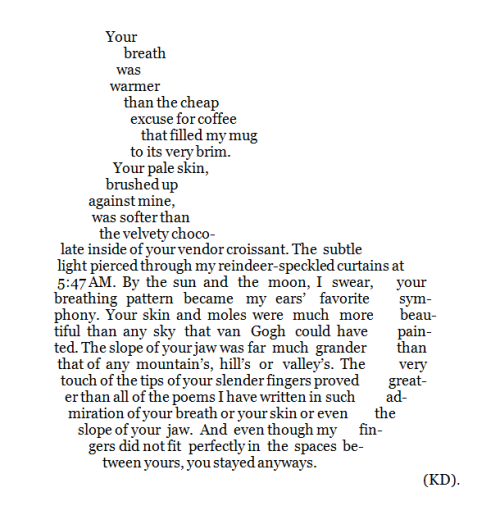
a concrete poem
by KD
This poem is proof that shape poems can be sophisticated, not simply clunky, childish strings of words fancied up using gimmicky typography. (There are plenty of examples of the latter online, however).

True confession: I don't exactly know who wrote this untitled piece and would love to give better attribution. I found it on someone's Tumblr page. I'd happily backlink the author if I could get an identity. My only clue is that this is someone from the Midwest or northern US or possibly Canada, where they use "anyways" rather than "anyway."

My favorite phrase here is "softer than the velvety chocolate inside of your vendor croissant."

What lines or images strike you?
Thursday, April 24, 2014 Laurel Garver
a concrete poem
by KD
This poem is proof that shape poems can be sophisticated, not simply clunky, childish strings of words fancied up using gimmicky typography. (There are plenty of examples of the latter online, however).

True confession: I don't exactly know who wrote this untitled piece and would love to give better attribution. I found it on someone's Tumblr page. I'd happily backlink the author if I could get an identity. My only clue is that this is someone from the Midwest or northern US or possibly Canada, where they use "anyways" rather than "anyway."

My favorite phrase here is "softer than the velvety chocolate inside of your vendor croissant."

What lines or images strike you?

Wednesday, April 23

Studying poetry will make you a better writer, no matter what genre you aspire to master. Poetry uses a number of techniques that I believe are quite transferable to other kinds of writing.

Today, I'd like to share a technique to "steal" from poets--using the sound device assonance (repeated vowel sounds) to ramp up the emotion in your fiction. The thinking behind sound devices is often onomatopoetic; the sound and meaning are linked.

morguefile.com

Consider these examples. Say them aloud. How do they make you feel?

1. John groped for his coat in hopes the Tylenol bottle hadn’t dropped through the hole in his pocket.

2. Lisa worried they'd think her rude if she cooed at their cute baby, so she chewed her lip while brooding on his tiny blue shoes.

3. Wading deeper into the creek, Ross felt the coldness seep through his sneakers. Shining eyes seemed to peek through the reeds. A cheeping frog sent a shriek of fear streaking up his spine, but he ground his teeth. Must stay silent. Must not be weak.


In my first example, Can you feel John's inner ache? The repeated oh, oh, aah, ahh,make the passage seem to moan and groan on the page. The repeated O sounds (both short and long) make you verbalize John's pain response.

In my second example, Lisa's entire inner monologue does coo at the cute baby, even if she refuses to do it aloud. The repeated long U sound carries it. This is an excellent, subtle way to add layers of meaning to your character's thoughts. Characters might consciously deny something while the sounds in their words convey a deeper, hidden, unconscious desire for the denied thing.

In my third example, the creepy feeling is reinforced by a series of little shrieks, like one might hear upon having a bug scurry over bare skin: Eeek! Ross is screaming inside, even if he's being tough and silent on the outside.

Your turn:
Chose an emotion you want to convey and think of the most primal sound you associate with it, such as Os for groaning with pain, Es for screaming with fright. Write a sentence, paragraph or scene in which you repeat the sounds.

Hint: a rhyming dictionary will help you identify words with the vowel sounds you need.

How might you use this technique today to improve your writing?
Wednesday, April 23, 2014 Laurel Garver
Studying poetry will make you a better writer, no matter what genre you aspire to master. Poetry uses a number of techniques that I believe are quite transferable to other kinds of writing.

Today, I'd like to share a technique to "steal" from poets--using the sound device assonance (repeated vowel sounds) to ramp up the emotion in your fiction. The thinking behind sound devices is often onomatopoetic; the sound and meaning are linked.

morguefile.com

Consider these examples. Say them aloud. How do they make you feel?

1. John groped for his coat in hopes the Tylenol bottle hadn’t dropped through the hole in his pocket.

2. Lisa worried they'd think her rude if she cooed at their cute baby, so she chewed her lip while brooding on his tiny blue shoes.

3. Wading deeper into the creek, Ross felt the coldness seep through his sneakers. Shining eyes seemed to peek through the reeds. A cheeping frog sent a shriek of fear streaking up his spine, but he ground his teeth. Must stay silent. Must not be weak.


In my first example, Can you feel John's inner ache? The repeated oh, oh, aah, ahh,make the passage seem to moan and groan on the page. The repeated O sounds (both short and long) make you verbalize John's pain response.

In my second example, Lisa's entire inner monologue does coo at the cute baby, even if she refuses to do it aloud. The repeated long U sound carries it. This is an excellent, subtle way to add layers of meaning to your character's thoughts. Characters might consciously deny something while the sounds in their words convey a deeper, hidden, unconscious desire for the denied thing.

In my third example, the creepy feeling is reinforced by a series of little shrieks, like one might hear upon having a bug scurry over bare skin: Eeek! Ross is screaming inside, even if he's being tough and silent on the outside.

Your turn:
Chose an emotion you want to convey and think of the most primal sound you associate with it, such as Os for groaning with pain, Es for screaming with fright. Write a sentence, paragraph or scene in which you repeat the sounds.

Hint: a rhyming dictionary will help you identify words with the vowel sounds you need.

How might you use this technique today to improve your writing?