Wednesday, June 25

Karen Gillan and Matt Smith in PHILLY! 
I don't typically let my geek flag fly as much as some bloggers do, but when I learned that the 11th Doctor and his companion Amy Pond were going to be in MY city, well...it was something that could not be missed.

This was my very first Comic Con. I don't read comic books. Superheroes...I can take 'em or leave 'em. Other than Wii Fit and online puzzle games, I don't really play video games either.

Waiting for the Dr. Who panel with the fourth Doctor!
But I was totally willing to rub elbows with the geekiest of geeks for a chance to see Matt Smith and Karen Gillan live. They have great chemistry, love to laugh, and are just so thankful to have been a part of SciFi's longest-running TV series. The Q&A session ran 90 minutes, and fans asked lots of really great questions beyond "what is your favorite memory?" I especially liked their thoughtful responses to what aspects of their characters do they wish there had been more time to develop. For Karen, it was the period when Amy went through four therapists trying to cure her obsession with "the raggedy man." Apparently the two have an ongoing rivalrly to see which can remember the season and episode number for the particular plots. (Matt won, I think.)

Over the years, these conventions have diversified, and now include all kinds of SciFi and fantasy cultural production, beyond comics and gamer culture. If you like Harry Potter, Lord of the Rings, Star Wars, Dr. Who, Torchwood, Orphan Black, Battlestar Galactica, Firefly, Game of Thrones, or The Walking Dead you won't feel entirely out of place at a Comic Con.

"Cosplay" is the term for all the amazing getups you are likely to see. Here's a small sampling.

Name those characters...'cause I can't.
Tim the Enchanter: "what is your favorite color?"

The boy wonder at Panera!

Sean has been acting since 1981. He's a busy guy!

The convention floor is largely a giant geek supermarket, where you can trade in or purchase an entire comic collection, pick up a light saber in the color of your choice (teal anyone?), build an enormous t-shirt collection, get signed films posters without the hassle of stalking stars, and turn your hard-earned cash into a cache of geeky gadgets and knickknacks.

My husband, daughter and I spent two days at the con, the first largely on the convention floor, the second largely attending Q&A panels with various TV and film stars. In addition to Karen Gillan and Matt Smith from Dr. Who, we also heard James Marsters from Buffy, Angel, Torchwood and others; Sean Astin, who you might know best as Samwise Gamgee from The Lord of the Rings films; and finally, Firefly and Serenity stars Alan Tudyk and Nathan Fillion.

The Firefly panel was by far the most crowded--standing room only. For a show that ran only one season, over ten years ago, it was pretty surprising it has such an enormous cult following. I think part of what keeps the show alive is these two guys. They continue to do lots of convention appearances and are completely hilarious together. Tudyk does lots of voice work for animated films, so at times he answered questions as King Candy from Wreck It Ralph or as the Duke of Weseleton from Frozen.

One of the funniest things they did was give out signed gifts to anyone brave enough to come to the microphone and ask questions. And those gifts? Random items from Alan Tudyk's bag--old mugs, t-shirts, script pages, a pack of gum. If there's any lesson to be learned, it's that fans absolutely adore starts who are approachable and willing to be a bit silly.

Have you ever attended a Comic Con? What questions would you have asked any of the stars I saw?
Wednesday, June 25, 2014 Laurel Garver
Karen Gillan and Matt Smith in PHILLY! 
I don't typically let my geek flag fly as much as some bloggers do, but when I learned that the 11th Doctor and his companion Amy Pond were going to be in MY city, well...it was something that could not be missed.

This was my very first Comic Con. I don't read comic books. Superheroes...I can take 'em or leave 'em. Other than Wii Fit and online puzzle games, I don't really play video games either.

Waiting for the Dr. Who panel with the fourth Doctor!
But I was totally willing to rub elbows with the geekiest of geeks for a chance to see Matt Smith and Karen Gillan live. They have great chemistry, love to laugh, and are just so thankful to have been a part of SciFi's longest-running TV series. The Q&A session ran 90 minutes, and fans asked lots of really great questions beyond "what is your favorite memory?" I especially liked their thoughtful responses to what aspects of their characters do they wish there had been more time to develop. For Karen, it was the period when Amy went through four therapists trying to cure her obsession with "the raggedy man." Apparently the two have an ongoing rivalrly to see which can remember the season and episode number for the particular plots. (Matt won, I think.)

Over the years, these conventions have diversified, and now include all kinds of SciFi and fantasy cultural production, beyond comics and gamer culture. If you like Harry Potter, Lord of the Rings, Star Wars, Dr. Who, Torchwood, Orphan Black, Battlestar Galactica, Firefly, Game of Thrones, or The Walking Dead you won't feel entirely out of place at a Comic Con.

"Cosplay" is the term for all the amazing getups you are likely to see. Here's a small sampling.

Name those characters...'cause I can't.
Tim the Enchanter: "what is your favorite color?"

The boy wonder at Panera!

Sean has been acting since 1981. He's a busy guy!

The convention floor is largely a giant geek supermarket, where you can trade in or purchase an entire comic collection, pick up a light saber in the color of your choice (teal anyone?), build an enormous t-shirt collection, get signed films posters without the hassle of stalking stars, and turn your hard-earned cash into a cache of geeky gadgets and knickknacks.

My husband, daughter and I spent two days at the con, the first largely on the convention floor, the second largely attending Q&A panels with various TV and film stars. In addition to Karen Gillan and Matt Smith from Dr. Who, we also heard James Marsters from Buffy, Angel, Torchwood and others; Sean Astin, who you might know best as Samwise Gamgee from The Lord of the Rings films; and finally, Firefly and Serenity stars Alan Tudyk and Nathan Fillion.

The Firefly panel was by far the most crowded--standing room only. For a show that ran only one season, over ten years ago, it was pretty surprising it has such an enormous cult following. I think part of what keeps the show alive is these two guys. They continue to do lots of convention appearances and are completely hilarious together. Tudyk does lots of voice work for animated films, so at times he answered questions as King Candy from Wreck It Ralph or as the Duke of Weseleton from Frozen.

One of the funniest things they did was give out signed gifts to anyone brave enough to come to the microphone and ask questions. And those gifts? Random items from Alan Tudyk's bag--old mugs, t-shirts, script pages, a pack of gum. If there's any lesson to be learned, it's that fans absolutely adore starts who are approachable and willing to be a bit silly.

Have you ever attended a Comic Con? What questions would you have asked any of the stars I saw?

Tuesday, June 17

By Tyrean Martinson

Photo credit: kconnors from morguefile.com 
We all find ourselves believing in the myth of “enough” time. With busy schedules, work, family activities, and much-needed relaxation time all competing for time in our lives, we often find ourselves wishing for a few more hours in a day or a week so that we could have “enough” time to pursue our writing or other creative pursuits. We chase the myth of “enough” time.


I homeschool my kids. I volunteer at my church. I teach classes at a homeschool co-operative and for that I must prep classroom exercises and homework for my students, and grade all their homework. I write stories, poetry, and novels. I like to ski, bike, read, and do fun activities with my family and friends. And, I never have “enough” time.

I have to make time.

When my kids were tiny, the time I could find for my writing came in the midst of their activities, or when they were sleeping. Most of the time, I wrote poems and snatches of stories when they were busy at play between lessons in early elementary school. I had to keep ideas written down in lists so that way when I had the chance for fifteen minutes of writing, that writing time was all writing time. No daydream or planning time could take place when I had the chance to sit down. I planned my ideas while folding laundry, doing dishes, or on my daily exercise walk. When I sat down to write, the pen hit the paper or my fingers hit the keyboard and went flying with no time for thought or worry over word choice in a rough draft, no time for planning a character’s emotional development or choosing actions to show the character’s emotional state. That had to happen outside of my writing moments. Then, three or four days a week, my husband would give me “alone” time with my writing for an hour or two. Again, I tried to focus that time on writing only. No e-mails, game playing, or daydream allowed – even about the story. Sometimes, during the long sessions, I actually had time for revision.

When my kids hit the older elementary years, they needed less of my “teaching” and more time of learning on their own – reading, doing math problems, writing, and doing science experiments without me hovering at their elbows. The reality is that although some learning is done during a lecture or discussion (or on the lap while reading when they were little), a lot of the connections and work take place when we are on our own and engaged with the material. My kids no longer needed me to read them all their lessons out loud, and they didn’t want me to. They needed me to plan, present, grade, and discuss, but for shorter bursts throughout the day. Other than that, they were happy to have me “out of the way” but engaged at a separate task near at hand for help.

Now, with a fiercely independent middle school kid and a high school kid with a lot of ideas and need to spend time with her friends, we’ve gone through more changes. My writing time and teacher preparation time has expanded, but I need to be ready to drop it at any moment throughout the day to present material/drive places/help with math conundrums/discuss serious matters of history, literature, and politics that arise from the curriculum we’ve chosen. It’s hard to write and then stop, and then write, and then stop, but I’ve found that it works for me most of the time. When I need a long, “solitary” session for writing or revising, I do that during my daughters’ activities: at the dance studio, in coffee shops, and even on the docks during kayaking. Overall, I usually feel that their learning and activity helps give me perspective in my writing and increases my creativity. (And I haven’t even mentioned how busy my talented husband gets – whew. The family calendar is full six days a week.)

The routines of writing have fallen into and around the routines of life. There is never a day when I feel I have “enough” time, but I find a way to make some for each activity, including writing. Some days I only get in a paragraph in my journal. Some days I type five pages. It all depends on the day. Goals are good, but I have long since left the “perfectionist” 1,000 words a day word count behind and tried for getting words on the paper each day and overall “realistic” monthly goals. Sometimes, I get up before everyone in my house does when I have an idea burning bright in my head at 4a.m. and sometimes I barely get any writing done while sitting in a car with rain pouring down while my youngest is kayaking in freezing water.

My tips to any and all busy writing parents are:


1. Take the writing time you have and use it to the fullest extent.

2. Set realistic monthly goals for whatever time of life you are in. I couldn’t write novels when my kids were in early elementary school and needed near constant attention and lap-time.

3. Use the time in which your kids are engaged in activities that they love – sports, dance, with friends – to benefit your writing.

How do you find time to write?

You can find Tyrean Martinson at Tyrean's Writing Spot and Twitter.

Her latest novel is Champion in Flight, book two in the Champion Trilogy

A year after she won the battle for Septily, Clara feels trapped in Skycliff by the Allied Council. As the last pieces of information about the Healing Caves fall into place, Clara is attacked by an assassin. Covert Drinaii mercenaries and the Council aren’t going to stop Clara from her quest to heal her broken blade. As Champion of Aramatir, she must act. Meanwhile, in the joint kingdoms of Rrysorria and Wylandria, the youngest and still cursed swan prince despairs of ever being whole again. In a moment of anger and desperation, Liam discovers a blood link between him and a dark sorceress.

Clara won the battle for Septily, but her battle isn’t over.

Champion in Flight is available at Smashwords and Amazon.

Tuesday, June 17, 2014 Laurel Garver
By Tyrean Martinson

Photo credit: kconnors from morguefile.com 
We all find ourselves believing in the myth of “enough” time. With busy schedules, work, family activities, and much-needed relaxation time all competing for time in our lives, we often find ourselves wishing for a few more hours in a day or a week so that we could have “enough” time to pursue our writing or other creative pursuits. We chase the myth of “enough” time.


I homeschool my kids. I volunteer at my church. I teach classes at a homeschool co-operative and for that I must prep classroom exercises and homework for my students, and grade all their homework. I write stories, poetry, and novels. I like to ski, bike, read, and do fun activities with my family and friends. And, I never have “enough” time.

I have to make time.

When my kids were tiny, the time I could find for my writing came in the midst of their activities, or when they were sleeping. Most of the time, I wrote poems and snatches of stories when they were busy at play between lessons in early elementary school. I had to keep ideas written down in lists so that way when I had the chance for fifteen minutes of writing, that writing time was all writing time. No daydream or planning time could take place when I had the chance to sit down. I planned my ideas while folding laundry, doing dishes, or on my daily exercise walk. When I sat down to write, the pen hit the paper or my fingers hit the keyboard and went flying with no time for thought or worry over word choice in a rough draft, no time for planning a character’s emotional development or choosing actions to show the character’s emotional state. That had to happen outside of my writing moments. Then, three or four days a week, my husband would give me “alone” time with my writing for an hour or two. Again, I tried to focus that time on writing only. No e-mails, game playing, or daydream allowed – even about the story. Sometimes, during the long sessions, I actually had time for revision.

When my kids hit the older elementary years, they needed less of my “teaching” and more time of learning on their own – reading, doing math problems, writing, and doing science experiments without me hovering at their elbows. The reality is that although some learning is done during a lecture or discussion (or on the lap while reading when they were little), a lot of the connections and work take place when we are on our own and engaged with the material. My kids no longer needed me to read them all their lessons out loud, and they didn’t want me to. They needed me to plan, present, grade, and discuss, but for shorter bursts throughout the day. Other than that, they were happy to have me “out of the way” but engaged at a separate task near at hand for help.

Now, with a fiercely independent middle school kid and a high school kid with a lot of ideas and need to spend time with her friends, we’ve gone through more changes. My writing time and teacher preparation time has expanded, but I need to be ready to drop it at any moment throughout the day to present material/drive places/help with math conundrums/discuss serious matters of history, literature, and politics that arise from the curriculum we’ve chosen. It’s hard to write and then stop, and then write, and then stop, but I’ve found that it works for me most of the time. When I need a long, “solitary” session for writing or revising, I do that during my daughters’ activities: at the dance studio, in coffee shops, and even on the docks during kayaking. Overall, I usually feel that their learning and activity helps give me perspective in my writing and increases my creativity. (And I haven’t even mentioned how busy my talented husband gets – whew. The family calendar is full six days a week.)

The routines of writing have fallen into and around the routines of life. There is never a day when I feel I have “enough” time, but I find a way to make some for each activity, including writing. Some days I only get in a paragraph in my journal. Some days I type five pages. It all depends on the day. Goals are good, but I have long since left the “perfectionist” 1,000 words a day word count behind and tried for getting words on the paper each day and overall “realistic” monthly goals. Sometimes, I get up before everyone in my house does when I have an idea burning bright in my head at 4a.m. and sometimes I barely get any writing done while sitting in a car with rain pouring down while my youngest is kayaking in freezing water.

My tips to any and all busy writing parents are:


1. Take the writing time you have and use it to the fullest extent.

2. Set realistic monthly goals for whatever time of life you are in. I couldn’t write novels when my kids were in early elementary school and needed near constant attention and lap-time.

3. Use the time in which your kids are engaged in activities that they love – sports, dance, with friends – to benefit your writing.

How do you find time to write?

You can find Tyrean Martinson at Tyrean's Writing Spot and Twitter.

Her latest novel is Champion in Flight, book two in the Champion Trilogy

A year after she won the battle for Septily, Clara feels trapped in Skycliff by the Allied Council. As the last pieces of information about the Healing Caves fall into place, Clara is attacked by an assassin. Covert Drinaii mercenaries and the Council aren’t going to stop Clara from her quest to heal her broken blade. As Champion of Aramatir, she must act. Meanwhile, in the joint kingdoms of Rrysorria and Wylandria, the youngest and still cursed swan prince despairs of ever being whole again. In a moment of anger and desperation, Liam discovers a blood link between him and a dark sorceress.

Clara won the battle for Septily, but her battle isn’t over.

Champion in Flight is available at Smashwords and Amazon.

Tuesday, June 10

Today special guest C.M. Keller is here to share insights into writing series and to tell us more about her latest release, Screwing up Alexandria. If you like learning about history, and also love an adventure story with a touch of humor and fantasy elements, you're sure to enjoy C.M. Keller's Screwing up Time series.

Could you tell us a little about Screwing up Alexandria?

Screwing Up Alexandria is the third book in the Screwing Up Time series. Here’s the blurb:

Time traveling has never brought Mark Montgomery anything but grief. And then, things get worse.
When Mark comes home from Babylon with a coded tablet, he never dreams someone would be willing to kill to get it. But they are.  So Mark and Miranda kidnap an ancient cryptographer named Nin and take her to the Library of Alexandria to decipher it.

The search for the truth of the tablet takes all of them to the most dangerous time on earth. And when Nin ends up on an altar surrounded by blood-thirsty crowds, only Mark can save her. But he’s blind.

What inspired you to set this book in Alexandria? 

I’ve always dreamed about the amazing library at Alexandria, where they tried to collect all knowledge of the ancient world. Can you imagine walking the halls? Reading the scrolls? Talking to the researchers?

What discoveries surprised you most when researching this book? 

While much of this novel takes place in Alexandria, Mark and Miranda also travel to the future and to ancient Uruk. I didn’t know much about Uruk when I started the book, but it’s a fascinating place and is known as “the Venice of the ancient world.”

Who were your favorite characters to write in this book?

I love Mark and Miranda, of course. But this book had a new character, Nin. And she was wonderful to write—she’s witty, clever, and always sure of herself, even when she’s wrong.

What was the hardest part of writing this book? 

So many difficult things were going on in my “real life” when I wrote this, and often I felt weary and worn-out. But writing the book was a wonderful opportunity to escape and relax.

What was the most fun? 

I loved writing Mark and Miranda’s interactions with Nin. Their repartee was a delight.

Is there a message in your novel that you want readers to grasp? 

I don’t really think about a message as I write a story because I let the characters tell their stories. But I know that the things I value are part of the characters’ stories. So issues like truth, perseverance, forgiveness, and doing hard things all figure into the plot.

What specific challenges come with writing a series?

One of the biggest challenges is keeping the stories fresh. But writing time travel it great because it gives me opportunities to explore new cultures and new people. In book one, Mark explored the Middle Ages and got to meet Miranda. In book two, he and Miranda went to Babylon and met Niri. In book three, Mark explores Alexandria, Uruk, and the future while meeting Nin and a whole host of secondary characters including a zoo keeper (until I started researching, I didn’t know that the library at Alexandria had a zoo) and a Jack Sparrow lookalike.

What piece of advice has helped you most as a writer?

I have two favorite writing quotes. One is from Jack London: “You can’t wait for inspiration. You have to go after it with a club.” And the other one (I don’t know who originally said it) is “A first draft is a celebration of everything that can go wrong on a page.”

These quotes really inspire me to sit down and do the work. Stories don’t write themselves. And they aren’t easy—they involve blood, sweat, and tears. And to alter a quote from The Princess Bride, “…anyone who says differently is trying to sell you something.” And yet, using your gift even though it’s difficult and messy, is a celebration and so much fun.

What is your background? 

I grew up all over the United States. I’ve lived in California, Illinois, Georgia, Hawaii, Connecticut, and Tennessee. I have a degree in English literature and worked at Harcourt. My husband and I have four kids, a black Lab, and a hamster.

How can readers connect with you?

I have two blogs. (Where you can be added to the Screwing Up Time mailing list, if you’d like.) http://screwinguptime.blogspot.com/ and http://connies-pen.blogspot.com/
My Twitter handle is @CMKellerWrites.
And I have a Facebook author page: https://www.facebook.com/pages/C-M-Keller/145636898869893

Get it now

Screwing up Alexandria is available at Amazon

Any other questions for Connie?
Tuesday, June 10, 2014 Laurel Garver
Today special guest C.M. Keller is here to share insights into writing series and to tell us more about her latest release, Screwing up Alexandria. If you like learning about history, and also love an adventure story with a touch of humor and fantasy elements, you're sure to enjoy C.M. Keller's Screwing up Time series.

Could you tell us a little about Screwing up Alexandria?

Screwing Up Alexandria is the third book in the Screwing Up Time series. Here’s the blurb:

Time traveling has never brought Mark Montgomery anything but grief. And then, things get worse.
When Mark comes home from Babylon with a coded tablet, he never dreams someone would be willing to kill to get it. But they are.  So Mark and Miranda kidnap an ancient cryptographer named Nin and take her to the Library of Alexandria to decipher it.

The search for the truth of the tablet takes all of them to the most dangerous time on earth. And when Nin ends up on an altar surrounded by blood-thirsty crowds, only Mark can save her. But he’s blind.

What inspired you to set this book in Alexandria? 

I’ve always dreamed about the amazing library at Alexandria, where they tried to collect all knowledge of the ancient world. Can you imagine walking the halls? Reading the scrolls? Talking to the researchers?

What discoveries surprised you most when researching this book? 

While much of this novel takes place in Alexandria, Mark and Miranda also travel to the future and to ancient Uruk. I didn’t know much about Uruk when I started the book, but it’s a fascinating place and is known as “the Venice of the ancient world.”

Who were your favorite characters to write in this book?

I love Mark and Miranda, of course. But this book had a new character, Nin. And she was wonderful to write—she’s witty, clever, and always sure of herself, even when she’s wrong.

What was the hardest part of writing this book? 

So many difficult things were going on in my “real life” when I wrote this, and often I felt weary and worn-out. But writing the book was a wonderful opportunity to escape and relax.

What was the most fun? 

I loved writing Mark and Miranda’s interactions with Nin. Their repartee was a delight.

Is there a message in your novel that you want readers to grasp? 

I don’t really think about a message as I write a story because I let the characters tell their stories. But I know that the things I value are part of the characters’ stories. So issues like truth, perseverance, forgiveness, and doing hard things all figure into the plot.

What specific challenges come with writing a series?

One of the biggest challenges is keeping the stories fresh. But writing time travel it great because it gives me opportunities to explore new cultures and new people. In book one, Mark explored the Middle Ages and got to meet Miranda. In book two, he and Miranda went to Babylon and met Niri. In book three, Mark explores Alexandria, Uruk, and the future while meeting Nin and a whole host of secondary characters including a zoo keeper (until I started researching, I didn’t know that the library at Alexandria had a zoo) and a Jack Sparrow lookalike.

What piece of advice has helped you most as a writer?

I have two favorite writing quotes. One is from Jack London: “You can’t wait for inspiration. You have to go after it with a club.” And the other one (I don’t know who originally said it) is “A first draft is a celebration of everything that can go wrong on a page.”

These quotes really inspire me to sit down and do the work. Stories don’t write themselves. And they aren’t easy—they involve blood, sweat, and tears. And to alter a quote from The Princess Bride, “…anyone who says differently is trying to sell you something.” And yet, using your gift even though it’s difficult and messy, is a celebration and so much fun.

What is your background? 

I grew up all over the United States. I’ve lived in California, Illinois, Georgia, Hawaii, Connecticut, and Tennessee. I have a degree in English literature and worked at Harcourt. My husband and I have four kids, a black Lab, and a hamster.

How can readers connect with you?

I have two blogs. (Where you can be added to the Screwing Up Time mailing list, if you’d like.) http://screwinguptime.blogspot.com/ and http://connies-pen.blogspot.com/
My Twitter handle is @CMKellerWrites.
And I have a Facebook author page: https://www.facebook.com/pages/C-M-Keller/145636898869893

Get it now

Screwing up Alexandria is available at Amazon

Any other questions for Connie?

Tuesday, June 3

After picking up a book that includes pretty pen drawings, like Nina LaCour's Hold Still  (see image below) or Kristen Hubbard's Wanderlove, the thought may occur to you indie authors: I could do that.

photo by amberinblunderland.blogspot.com
You could. But there are a few things you ought to know about the technical side, especially for producing a print version of your book.

I've worked directly with printers on everything from full-color magazines to posters and brochures (as a managing editor and a graphic designer). One important lesson I learned is that every set of equipment has its own vagaries in terms of how it lays ink on the page and how it handles paper. It's almost impossible to have quality control over images when you can't work directly with vendors. But you can get better results if you make design decisions that take certain issues into account.

Below are a few key concepts you need to know about one-color printing (black ink on pale paper) so you (or any designer you hire) can create designs that consistently reproduce well in a print-on-demand environment.

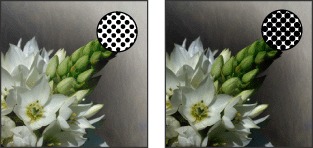
dot gain

Every printed image is made up of a series of ink droplets. Some machinery has the tendency to be overwet in feeding ink, so the dots can spread (or the dot pattern can enlarge going from computer to press). That's called "dot gain" by the industry pros. Other machinery can be a little stingy with ink, resulting in "dot loss," or a less intense, somewhat washed out look.
Dot gain illustrated (image: underwaterphotography.com)

When dealing with solid blacks, dot gain is often not noticeable to an untrained eye. And dot loss is something most printers vigilantly check for.

But when it comes to what are called grayscale images--like black and white photographs, pencil drawings, or pen-and-ink illustration that has shading created with pointillism or fine cross-hatching--dot gain or loss can seriously mar the final printed product.

Bold line art will hold up better across a variety of machines than grayscale images. Thick lines and less detail should yield the very best results.

If you're working with clip art, you want an EPS file or what's called a "vector graphic," rather than a TIFF (tagged image file format), because it won't pixelate if you enlarge it.

Any hand drawing should be done on the smoothest, whitest paper you can buy. When scanning the image, follow these helpful tips.

bleed tolerance

A "bleed" in printing is an image that extends off the edge of the page. CreateSpace allows you to have interior images that bleed and gives very specific instructions for doing that, which I quote below:

Does your book contain images?

If you want your images to bleed to the edges of your book, ensure that they extend at least .125" beyond the final trim size from the top, bottom and outer edges and submit your PDF .25" higher and .125" wider than your selected trim size to accommodate the full bleed area.
Keep in mind all live elements must be at least .25" away from the trim lines, so if your file is formatted to be full bleed all live elements should be .375" away from the edge of the page.   
© CreateSpace, 2014
But here's the rub: not every copy of your book will necessarily print on the same press; print on demand means it typically prints closest to where it will ship. Some presses have a marginally different "tolerance" (an "allowed quantitative difference" aka wiggle room, slip, what have you; see an example here). CreateSpace tries to account for this by having relatively large bleed areas and trim tolerances (.25 compared to .125 of most printers). That way you'll never end up with an image that floats with white space around it when it's supposed to hang off the edge of the page. But you could end up having an image trimmed more severely than you anticipated.

Bleed tolerance example  (image by 48HourPrint.com)

All that to say, be mindful that any image that bleeds could cut off just a bit differently than it looks like it will in your page layout software. Make sure detailed bits, like lettering, are well inside the safety area.

What do you think of adding illustrations to books? Too scary or worth the effort?
Tuesday, June 03, 2014 Laurel Garver
After picking up a book that includes pretty pen drawings, like Nina LaCour's Hold Still  (see image below) or Kristen Hubbard's Wanderlove, the thought may occur to you indie authors: I could do that.

photo by amberinblunderland.blogspot.com
You could. But there are a few things you ought to know about the technical side, especially for producing a print version of your book.

I've worked directly with printers on everything from full-color magazines to posters and brochures (as a managing editor and a graphic designer). One important lesson I learned is that every set of equipment has its own vagaries in terms of how it lays ink on the page and how it handles paper. It's almost impossible to have quality control over images when you can't work directly with vendors. But you can get better results if you make design decisions that take certain issues into account.

Below are a few key concepts you need to know about one-color printing (black ink on pale paper) so you (or any designer you hire) can create designs that consistently reproduce well in a print-on-demand environment.

dot gain

Every printed image is made up of a series of ink droplets. Some machinery has the tendency to be overwet in feeding ink, so the dots can spread (or the dot pattern can enlarge going from computer to press). That's called "dot gain" by the industry pros. Other machinery can be a little stingy with ink, resulting in "dot loss," or a less intense, somewhat washed out look.
Dot gain illustrated (image: underwaterphotography.com)

When dealing with solid blacks, dot gain is often not noticeable to an untrained eye. And dot loss is something most printers vigilantly check for.

But when it comes to what are called grayscale images--like black and white photographs, pencil drawings, or pen-and-ink illustration that has shading created with pointillism or fine cross-hatching--dot gain or loss can seriously mar the final printed product.

Bold line art will hold up better across a variety of machines than grayscale images. Thick lines and less detail should yield the very best results.

If you're working with clip art, you want an EPS file or what's called a "vector graphic," rather than a TIFF (tagged image file format), because it won't pixelate if you enlarge it.

Any hand drawing should be done on the smoothest, whitest paper you can buy. When scanning the image, follow these helpful tips.

bleed tolerance

A "bleed" in printing is an image that extends off the edge of the page. CreateSpace allows you to have interior images that bleed and gives very specific instructions for doing that, which I quote below:

Does your book contain images?

If you want your images to bleed to the edges of your book, ensure that they extend at least .125" beyond the final trim size from the top, bottom and outer edges and submit your PDF .25" higher and .125" wider than your selected trim size to accommodate the full bleed area.
Keep in mind all live elements must be at least .25" away from the trim lines, so if your file is formatted to be full bleed all live elements should be .375" away from the edge of the page.   
© CreateSpace, 2014
But here's the rub: not every copy of your book will necessarily print on the same press; print on demand means it typically prints closest to where it will ship. Some presses have a marginally different "tolerance" (an "allowed quantitative difference" aka wiggle room, slip, what have you; see an example here). CreateSpace tries to account for this by having relatively large bleed areas and trim tolerances (.25 compared to .125 of most printers). That way you'll never end up with an image that floats with white space around it when it's supposed to hang off the edge of the page. But you could end up having an image trimmed more severely than you anticipated.

Bleed tolerance example  (image by 48HourPrint.com)

All that to say, be mindful that any image that bleeds could cut off just a bit differently than it looks like it will in your page layout software. Make sure detailed bits, like lettering, are well inside the safety area.

What do you think of adding illustrations to books? Too scary or worth the effort?

Thursday, May 29

Today, I'm going to cover some of the basics of expressing ownership in writing, because it's something I frequently see mangled in shop windows, on billboards, and in manuscripts.

These rules apply to NOUNS only. For the rules on possessive pronouns, see this post: It's your day to master tricky possessives.

photo by Jade, morguefile.com

Singular nouns

To indicate ownership, add an apostrophe and S to singular nouns (no matter what the ending consonant) Some examples are below.

John's box
Yeats's poems
Dickens's novels
Josh's guitar
Dax's leadership
Inez's marimba

Some style guides make an exception for certain Greek names ending in S: Jesus' life, Demosthenes' pebbles. If you chose to do this, be consistent. 

Plural nouns

First, correctly form the plural.
~Most simply take an S (including names that end with a Y)
~Words and names ending with a sibilant sound such as CH, S, SH, X or Z take an ES ending
~Many common nouns ending in Y take an IES ending
~Some semi-irregular nouns will change the final consonant and take an ES
~Certain Latin words will switch from IS to ES
~Irregular nouns will mutate, including some Latin, Greek, and French words.
When in doubt, look it up. Here's a useful list of oddball plural forms.

With plural nouns ending in s, indicate ownership by adding an apostrophe alone.
For irregular plurals that don't end in an S, indicate ownership by adding an apostrophe and an S (just like a singular noun).

Some examples are below.

With a simple ending:
girls' first win
games' culmination
magicians' secrets
Smiths' deck
Grants' party
boys' turn
turkeys' pen
O'Reillys' bar

With a sibilant ending:
boxes' contents
fezzes' tassels
churches' service times
Rosses' ranch
Collinses' house
Mirouxes' vineyard
Sanchezes' boat

Y ending common nouns:
babies' cribs
puppies' owners
categories' rules
deliveries' arrival

Semi-irregular nouns:
(loaf) loaves' ingredients
(wife) wives' opinions
(elf) elves' fortress
(matrix) matrices' origins

Latin end-vowel changers:
(crisis) crises' causes
(parenthesis) parentheses' color
(oasis) oases' merchants

Irregular nouns:
(mouse) mice's cages
(goose) geese's nests
(ox) oxen's stalls
(child) children's menu
(man) men's restroom
(medium) media's constraints
(curriculum) curricula's format
(fungus) fungi's characteristics
(beau) beaux's names and numbers

Note: If you struggle with apostrophes, avoid giving characters first names ending in s (like Alexis or Joss) or last names ending in s, sh, ch, x or z (like Robbins, Marsh, Koch, Leax, Lopez). You'll eliminate many headaches and confusion for yourself.

Mixed groups

Generally you want the same number of apostrophes as items possessed.

For shared ownership, one apostrophe:
Jane and Jordan's new apartment
Frost and Wright's collection

Similar items that are owned (or were created) by separate people or entities take multiple apostrophes:
Kimball's and Jones's books on the Civil War
Girls' and boys' locker rooms
Owen's and the Mosses' cars

With mixed combinations (like a single person and a couple), make the number of apostrophes match the number of items:
The tree fell on Tim's and Dave and Becky's houses.
Two houses, two apostrophes.


Probably the most common errors occur with names ending in S where it's unclear whether you're dealing with one person or a group. You can go to Ross's house or the Rosses' house, but please don't ever talk about Ross' house. It's just confusing.

Which of these things tend to trip you up? 
Thursday, May 29, 2014 Laurel Garver
Today, I'm going to cover some of the basics of expressing ownership in writing, because it's something I frequently see mangled in shop windows, on billboards, and in manuscripts.

These rules apply to NOUNS only. For the rules on possessive pronouns, see this post: It's your day to master tricky possessives.

photo by Jade, morguefile.com

Singular nouns

To indicate ownership, add an apostrophe and S to singular nouns (no matter what the ending consonant) Some examples are below.

John's box
Yeats's poems
Dickens's novels
Josh's guitar
Dax's leadership
Inez's marimba

Some style guides make an exception for certain Greek names ending in S: Jesus' life, Demosthenes' pebbles. If you chose to do this, be consistent. 

Plural nouns

First, correctly form the plural.
~Most simply take an S (including names that end with a Y)
~Words and names ending with a sibilant sound such as CH, S, SH, X or Z take an ES ending
~Many common nouns ending in Y take an IES ending
~Some semi-irregular nouns will change the final consonant and take an ES
~Certain Latin words will switch from IS to ES
~Irregular nouns will mutate, including some Latin, Greek, and French words.
When in doubt, look it up. Here's a useful list of oddball plural forms.

With plural nouns ending in s, indicate ownership by adding an apostrophe alone.
For irregular plurals that don't end in an S, indicate ownership by adding an apostrophe and an S (just like a singular noun).

Some examples are below.

With a simple ending:
girls' first win
games' culmination
magicians' secrets
Smiths' deck
Grants' party
boys' turn
turkeys' pen
O'Reillys' bar

With a sibilant ending:
boxes' contents
fezzes' tassels
churches' service times
Rosses' ranch
Collinses' house
Mirouxes' vineyard
Sanchezes' boat

Y ending common nouns:
babies' cribs
puppies' owners
categories' rules
deliveries' arrival

Semi-irregular nouns:
(loaf) loaves' ingredients
(wife) wives' opinions
(elf) elves' fortress
(matrix) matrices' origins

Latin end-vowel changers:
(crisis) crises' causes
(parenthesis) parentheses' color
(oasis) oases' merchants

Irregular nouns:
(mouse) mice's cages
(goose) geese's nests
(ox) oxen's stalls
(child) children's menu
(man) men's restroom
(medium) media's constraints
(curriculum) curricula's format
(fungus) fungi's characteristics
(beau) beaux's names and numbers

Note: If you struggle with apostrophes, avoid giving characters first names ending in s (like Alexis or Joss) or last names ending in s, sh, ch, x or z (like Robbins, Marsh, Koch, Leax, Lopez). You'll eliminate many headaches and confusion for yourself.

Mixed groups

Generally you want the same number of apostrophes as items possessed.

For shared ownership, one apostrophe:
Jane and Jordan's new apartment
Frost and Wright's collection

Similar items that are owned (or were created) by separate people or entities take multiple apostrophes:
Kimball's and Jones's books on the Civil War
Girls' and boys' locker rooms
Owen's and the Mosses' cars

With mixed combinations (like a single person and a couple), make the number of apostrophes match the number of items:
The tree fell on Tim's and Dave and Becky's houses.
Two houses, two apostrophes.


Probably the most common errors occur with names ending in S where it's unclear whether you're dealing with one person or a group. You can go to Ross's house or the Rosses' house, but please don't ever talk about Ross' house. It's just confusing.

Which of these things tend to trip you up? 

Tuesday, May 20

image by penywise at morguefile.com
What happens to your writing projects when you just can't write? Maybe your day job is suddenly demanding 80-hour weeks, or a family member is in crisis, or this week is the charity fund raiser, or you've been hit hard with an illness (that's me--bronchitis, very slow recovery). Most of the time, one abruptly drops the projects and runs to the crisis du jour. That's natural and sane. Running yourself into the ground does no one any good.

Yet, your writing project can stall. And when you come back to it, you don't know where to pick up.

When this happens, it can take weeks to get back on track--weeks of deep doubt and fear. You worry your inertia is because the story idea is stupid; you can't remember why you ever liked your characters. You write 1,000 words and delete 780 of them, day after day.

Don't let this happen to you. There are some simple ways to stay connected with your project, even when you can't dedicate hours (or even half hours) to writing.

My friend, author Heidi Willis shared this powerful idea on her blog a few months ago, and I've found it encouraging, because it's both strict and permissive: Touch it every day. (I can hear you all sniggering like middle schoolers. Grow up and let's move on.)

"Touch it every day" means find some way, daily, to keep checking in on your project, whether or not you're able to add pages. Here are some things I've done and some additional things I plan to try:

"Reel it" 

Imagine possible permutations of a future scene, playing them through in your mind like a film. This is especially good for when you are sick or stuck driving people all over town. More on this technique HERE.

Research 

In Story, Robert McKee says, "No matter how talented, the ignorant cannot write. Talent must be stimulated by facts and ideas. Do research. Feed your talent. Research not only wins the war on cliche, it's the key to victory over fear and its cousin, depression."

Research is often more portable than creative work. You can read books and articles while sitting in a hospital room with an ill loved one, or while the kids are at soccer practice, or while standing in line at the grocery store. Smart phone owners have an advantage, but even those without portable Internet can have research materials on hand--articles you print and set aside, books you download onto your ereader.

The key here is to stay curious about everything that touches your story world. Read about birth order and regional food traditions and interior design and pop culture and your characters' hobbies. Read about politics and economics and history and scientific discoveries. Never stop learning, never stop feeding your mind: STAY CURIOUS.

Interview

Keep your radar attuned to people you meet who might know something about your story world and bravely ask questions. I once got some amazing research done while at a church luncheon. I was seated by a friend who is a speech-language pathologist, and realized she might know something about speech problems in stroke patients, an element in my story. So I said, "I'm working on a story in which a grandparent has a stroke. What kind of speech problems might he possibly have?" That short chat was more focused and helpful than hours of reading. She knew in practice, not just theory, how patients behave and what the stages of recovery look like. That kind of information is pure gold.

This technique is great for those socially-demanding seasons when you shuttle from wedding to graduation to baby shower. Think about how your story might connect to every person you meet. Tap their knowledge and expertise as a family member, volunteer or professional. People love to be considered experts.

Observe

You can also take advantage of socially demanding times to people watch. Look for interesting gestures, ways of moving through space, fashion sense. Listen for opinions, attitudes, great catchphrases and slang. Always have a few index cards stuffed in your pockets or handbag, or use my guided journal Emotions in the Wild to jot down your observations. You never know when the embodiment of one of your characters will suddenly wander onto the train platform, sit at your table at the reception, or pass you on the convention floor.

Brainstorm

Think through any and every part of the story yet to be written, or parts you want to revise. Brainstorming is a great umbrella term for all kinds of creative thought processes that can fit any writer's style.

  • Make big, sprawling, messy mind maps. 
  • Neatly write notecards with individual plot points you can later sort and order. 
  • Interview your characters. 
  • Write journal entries in a character's voice.
  • Write out discussions with your characters about your revision ideas. 
  • Jot ideas to research.
  • Develop backstories for everyone, even if only slivers or hints will be used in the story.
  • Preplan scenes and what will change in each one.
  • Doodle maps of your locations, including home interior layouts.

Brainstorming can be very portable and you can do it even when you're too feverish to hold a pen. Those fitful hours in bed can be rich with imagined conversations with characters and imagined walks through your fictional spaces. Love and inhabit your story world every day.

How do you stay connected to your story when you can't write? Which of these techniques might you try?
Tuesday, May 20, 2014 Laurel Garver
image by penywise at morguefile.com
What happens to your writing projects when you just can't write? Maybe your day job is suddenly demanding 80-hour weeks, or a family member is in crisis, or this week is the charity fund raiser, or you've been hit hard with an illness (that's me--bronchitis, very slow recovery). Most of the time, one abruptly drops the projects and runs to the crisis du jour. That's natural and sane. Running yourself into the ground does no one any good.

Yet, your writing project can stall. And when you come back to it, you don't know where to pick up.

When this happens, it can take weeks to get back on track--weeks of deep doubt and fear. You worry your inertia is because the story idea is stupid; you can't remember why you ever liked your characters. You write 1,000 words and delete 780 of them, day after day.

Don't let this happen to you. There are some simple ways to stay connected with your project, even when you can't dedicate hours (or even half hours) to writing.

My friend, author Heidi Willis shared this powerful idea on her blog a few months ago, and I've found it encouraging, because it's both strict and permissive: Touch it every day. (I can hear you all sniggering like middle schoolers. Grow up and let's move on.)

"Touch it every day" means find some way, daily, to keep checking in on your project, whether or not you're able to add pages. Here are some things I've done and some additional things I plan to try:

"Reel it" 

Imagine possible permutations of a future scene, playing them through in your mind like a film. This is especially good for when you are sick or stuck driving people all over town. More on this technique HERE.

Research 

In Story, Robert McKee says, "No matter how talented, the ignorant cannot write. Talent must be stimulated by facts and ideas. Do research. Feed your talent. Research not only wins the war on cliche, it's the key to victory over fear and its cousin, depression."

Research is often more portable than creative work. You can read books and articles while sitting in a hospital room with an ill loved one, or while the kids are at soccer practice, or while standing in line at the grocery store. Smart phone owners have an advantage, but even those without portable Internet can have research materials on hand--articles you print and set aside, books you download onto your ereader.

The key here is to stay curious about everything that touches your story world. Read about birth order and regional food traditions and interior design and pop culture and your characters' hobbies. Read about politics and economics and history and scientific discoveries. Never stop learning, never stop feeding your mind: STAY CURIOUS.

Interview

Keep your radar attuned to people you meet who might know something about your story world and bravely ask questions. I once got some amazing research done while at a church luncheon. I was seated by a friend who is a speech-language pathologist, and realized she might know something about speech problems in stroke patients, an element in my story. So I said, "I'm working on a story in which a grandparent has a stroke. What kind of speech problems might he possibly have?" That short chat was more focused and helpful than hours of reading. She knew in practice, not just theory, how patients behave and what the stages of recovery look like. That kind of information is pure gold.

This technique is great for those socially-demanding seasons when you shuttle from wedding to graduation to baby shower. Think about how your story might connect to every person you meet. Tap their knowledge and expertise as a family member, volunteer or professional. People love to be considered experts.

Observe

You can also take advantage of socially demanding times to people watch. Look for interesting gestures, ways of moving through space, fashion sense. Listen for opinions, attitudes, great catchphrases and slang. Always have a few index cards stuffed in your pockets or handbag, or use my guided journal Emotions in the Wild to jot down your observations. You never know when the embodiment of one of your characters will suddenly wander onto the train platform, sit at your table at the reception, or pass you on the convention floor.

Brainstorm

Think through any and every part of the story yet to be written, or parts you want to revise. Brainstorming is a great umbrella term for all kinds of creative thought processes that can fit any writer's style.

  • Make big, sprawling, messy mind maps. 
  • Neatly write notecards with individual plot points you can later sort and order. 
  • Interview your characters. 
  • Write journal entries in a character's voice.
  • Write out discussions with your characters about your revision ideas. 
  • Jot ideas to research.
  • Develop backstories for everyone, even if only slivers or hints will be used in the story.
  • Preplan scenes and what will change in each one.
  • Doodle maps of your locations, including home interior layouts.

Brainstorming can be very portable and you can do it even when you're too feverish to hold a pen. Those fitful hours in bed can be rich with imagined conversations with characters and imagined walks through your fictional spaces. Love and inhabit your story world every day.

How do you stay connected to your story when you can't write? Which of these techniques might you try?

Friday, May 16

It seemed high time for another Phonics Friday post. Today we'll tackle a set of fraternal triplets of language, the homophones meat, meet and mete. Once again, I'll provide a definition, examples and mnemonic tricks to help you keep them straight.

meat


Photo credit: mconnors from morguefile.com
meat (n.) flesh; the flesh of an animal used as food; the edible part or kernel of certain plant fruits (such as a walnut or coconut).

(n.) at the core of something; the most important part of something.

Examples

  • The chef's knife slipped, slicing the meat of his palm.
  • Rudy is vegan; the only meat he eats is coconut meat and other nut meats.
  • The meat of the issue is fairness and equality.
  • Your topic is very meaty. Can you keep the paper under ten pages?

Mnemonic
Andy ate meat at all meals.

meet


Photo credit: diggerdanno from morguefile.com
meet (v., trans.) met, meeting -  to encounter or come into contact; to become acquainted;  to gather with others, especially at a particular place and time; to come together for a common purpose

 - to provide for or pay fully; to cope with

- to conform precisely; to form a junction

- to have or receive a particular reaction

 meet (n.) - a gathering of athletes for a sports competition; a gathering to hunt foxes

meet (adj., archaic) - suitable; made to fit

Examples

  • I can't wait to meet Jane's twin brother.
  • Lois met us at noon to carpool to the swim meet.
  • His higher salary will meet all the family's financial needs.
  • Carlos thinks his candidate meets all the requirements best.
  • Thorn Road meets Blueberry Lane just past the post office.
  • His proposal was met with applause and cheers.
  • Phua placed third in 500 meter hurdles at the track meet.
  • Count Roderigo felt it meet that she should attend the coronation.

Mnemonic
Bree is free to meet new people

mete

Photo credit: cohdra from morguefile.com
mete (v., trans.) meted, meting -  to allot or dole out justice or punishment (usually with out)
- (archaic) to measure

Examples

  • The queen will mete out justice to the highwaymen terrorizing her land.
  • Harken the ways of yon fishmonger who metes not fair portions of his trout.

Mnemonic
Pete theatened to mete out concrete shoes for any athlete who dares to compete.


The handful of archaic forms are where troubles arise most. "It is meet that I should thus mete your portion of the meat from our meet" is not a sentence you're likely to see outside historical fiction or fantasy.

Which of these new definitions were new to you? What other homophones tend to trip you up?
Friday, May 16, 2014 Laurel Garver
It seemed high time for another Phonics Friday post. Today we'll tackle a set of fraternal triplets of language, the homophones meat, meet and mete. Once again, I'll provide a definition, examples and mnemonic tricks to help you keep them straight.

meat


Photo credit: mconnors from morguefile.com
meat (n.) flesh; the flesh of an animal used as food; the edible part or kernel of certain plant fruits (such as a walnut or coconut).

(n.) at the core of something; the most important part of something.

Examples

  • The chef's knife slipped, slicing the meat of his palm.
  • Rudy is vegan; the only meat he eats is coconut meat and other nut meats.
  • The meat of the issue is fairness and equality.
  • Your topic is very meaty. Can you keep the paper under ten pages?

Mnemonic
Andy ate meat at all meals.

meet


Photo credit: diggerdanno from morguefile.com
meet (v., trans.) met, meeting -  to encounter or come into contact; to become acquainted;  to gather with others, especially at a particular place and time; to come together for a common purpose

 - to provide for or pay fully; to cope with

- to conform precisely; to form a junction

- to have or receive a particular reaction

 meet (n.) - a gathering of athletes for a sports competition; a gathering to hunt foxes

meet (adj., archaic) - suitable; made to fit

Examples

  • I can't wait to meet Jane's twin brother.
  • Lois met us at noon to carpool to the swim meet.
  • His higher salary will meet all the family's financial needs.
  • Carlos thinks his candidate meets all the requirements best.
  • Thorn Road meets Blueberry Lane just past the post office.
  • His proposal was met with applause and cheers.
  • Phua placed third in 500 meter hurdles at the track meet.
  • Count Roderigo felt it meet that she should attend the coronation.

Mnemonic
Bree is free to meet new people

mete

Photo credit: cohdra from morguefile.com
mete (v., trans.) meted, meting -  to allot or dole out justice or punishment (usually with out)
- (archaic) to measure

Examples

  • The queen will mete out justice to the highwaymen terrorizing her land.
  • Harken the ways of yon fishmonger who metes not fair portions of his trout.

Mnemonic
Pete theatened to mete out concrete shoes for any athlete who dares to compete.


The handful of archaic forms are where troubles arise most. "It is meet that I should thus mete your portion of the meat from our meet" is not a sentence you're likely to see outside historical fiction or fantasy.

Which of these new definitions were new to you? What other homophones tend to trip you up?