Wednesday, January 20

In a previous post, How I do it: keeping revisions organized, I discussed my method for tracing particular revision threads throughout a  novel manuscript, tracking them, developing a running list of changes, and methodically tackling those changes.

One of my young writer friends, after reading the post asked, "but how did you figure out what the problems actually were?"
Image credit: clairer at morguefile.com

I rely a good deal on my intuition when it comes to writing decisions, but I also have a pretty strong analytical side that I call on when editing especially. So when it comes time to revise, I have to get these two impulses to play nice.

Once I've wrapped a piece, be it a short story, poem, or novel, I take a break from it for a bit. Catch up on chores. Read. Stream TV shows or movies. Not too long a writing vacation, mind you--just a few days to week.

Then it's time to do a critical read through, scene by scene. The critical read has several components: gut responses, intellect responses, craft concerns. As I read scene by scene, I contemplate the following questions.

Gut responses


  • Is this scene boring? 
  • Does it feel silly or improbable?
  • Am I engaged? Do I feel something or think something after reading it?
  • Does the scene feel too slow in spots? 
  • Does it feel too quick, not escalating naturally, but blowing right past natural reactions and sequences of events? (More on escalation HERE.)
  • Do I buy what the characters do? Do they seem needlessly stupid, thoughtless, malicious, overreacting, under-reacting, etc.?    (Note: The adverb "needlessly" is important, because bad behavior is a key component of dramatic storytelling, but unmotivated or out of the blue behavior that can't be accounted for is more often a sign that something needs to be fixed.)
  • Does the scene feel like I picked the first idea that popped into my head, rather than the best one?
  • Does the scene feel cowardly, like I've written away from a difficult or controversial reality?
  • Does the scene give me a sense of deja vu, like it's a rehash of something I've seen somewhere else? 
  • Does the scene make me want to keep reading?
  • Does the scene as a whole feel on target?

Intellect responses


  • Are the actions here natural? Do they make sense?
  • Am I certain I have the facts straight? Have I adequately researched this to be sure?
  • Are characters acting in a way out of alignment with how I've conceived them?
  • Do the characters' responses connect with what came before?
  • Are the characters' responses and actions the best ones to lead toward my climax and resolution?
  • Is the protagonist blowing his/her chance at being likable?
  • Have the relationships shown change and growth?
  • Have any new characters shown up? Is this the best place to introduce them? Have they appeared out of nowhere late in the story and need to be "seeded" in earlier?
  • Are the characters acting at their maximum capacity (more on this concept HERE)? If not, does their reason for holding back or messing up make sense and do something useful in the story?
  • Is there tension? Is it only one kind (say only romantic, or only physical danger)?
  • Are characters using different tools to negotiate to get what they want (more on negotiation tools HERE)? Or is the interpersonal conflict too much of the same scene after scene?
  • Is the scene pulling its weight? Do the actions here add enough forward motion? 

Craft concerns


  • Is the protagonist's emotional pulse (the driving desire behind his/her arc) coming through?
  • Is this scene happening at the right moment in the overall story arc? Would it work better somewhere else?
  • Does the scene have a discernible beginning, middle and end--a mini arc? If not, what's missing?
  • Is there too much "stage business"--unnecessary descriptions of boring movement here to there?
  • Have I given enough detail to ground where and when the scene is happening?
  • Is there variety in the settings where scenes occur?
  • Has a new subplot popped up here? Does it add anything?
  • Have I missed any opportunities to more deeply develop theme or symbolism?
  • Have I missed opportunities to develop existing conflicts?
  • Have I used too many of the same kind of scene in a row? Am I regularly mixing dialogue scenes with action scenes and narrative summary scenes?
  • Does this scene deserve to be dramatized? Would it work better as summary?
  • Are the most important moments given the most page space? Are there unimportant bits running too long, out or proportion to their importance in the overall story?

As you can see, these three levels or layers of thinking draw on one's emotion and intuition, one's natural intellect, and finally the "best practices" advice of writing craft books. At times, it takes more than one read-through to engage each part of one's self--the feeling reader, the thinker, and the trained craftsman.

How do you identify major threads of revision needed in your work?

Wednesday, January 20, 2016 Laurel Garver
In a previous post, How I do it: keeping revisions organized, I discussed my method for tracing particular revision threads throughout a  novel manuscript, tracking them, developing a running list of changes, and methodically tackling those changes.

One of my young writer friends, after reading the post asked, "but how did you figure out what the problems actually were?"
Image credit: clairer at morguefile.com

I rely a good deal on my intuition when it comes to writing decisions, but I also have a pretty strong analytical side that I call on when editing especially. So when it comes time to revise, I have to get these two impulses to play nice.

Once I've wrapped a piece, be it a short story, poem, or novel, I take a break from it for a bit. Catch up on chores. Read. Stream TV shows or movies. Not too long a writing vacation, mind you--just a few days to week.

Then it's time to do a critical read through, scene by scene. The critical read has several components: gut responses, intellect responses, craft concerns. As I read scene by scene, I contemplate the following questions.

Gut responses


  • Is this scene boring? 
  • Does it feel silly or improbable?
  • Am I engaged? Do I feel something or think something after reading it?
  • Does the scene feel too slow in spots? 
  • Does it feel too quick, not escalating naturally, but blowing right past natural reactions and sequences of events? (More on escalation HERE.)
  • Do I buy what the characters do? Do they seem needlessly stupid, thoughtless, malicious, overreacting, under-reacting, etc.?    (Note: The adverb "needlessly" is important, because bad behavior is a key component of dramatic storytelling, but unmotivated or out of the blue behavior that can't be accounted for is more often a sign that something needs to be fixed.)
  • Does the scene feel like I picked the first idea that popped into my head, rather than the best one?
  • Does the scene feel cowardly, like I've written away from a difficult or controversial reality?
  • Does the scene give me a sense of deja vu, like it's a rehash of something I've seen somewhere else? 
  • Does the scene make me want to keep reading?
  • Does the scene as a whole feel on target?

Intellect responses


  • Are the actions here natural? Do they make sense?
  • Am I certain I have the facts straight? Have I adequately researched this to be sure?
  • Are characters acting in a way out of alignment with how I've conceived them?
  • Do the characters' responses connect with what came before?
  • Are the characters' responses and actions the best ones to lead toward my climax and resolution?
  • Is the protagonist blowing his/her chance at being likable?
  • Have the relationships shown change and growth?
  • Have any new characters shown up? Is this the best place to introduce them? Have they appeared out of nowhere late in the story and need to be "seeded" in earlier?
  • Are the characters acting at their maximum capacity (more on this concept HERE)? If not, does their reason for holding back or messing up make sense and do something useful in the story?
  • Is there tension? Is it only one kind (say only romantic, or only physical danger)?
  • Are characters using different tools to negotiate to get what they want (more on negotiation tools HERE)? Or is the interpersonal conflict too much of the same scene after scene?
  • Is the scene pulling its weight? Do the actions here add enough forward motion? 

Craft concerns


  • Is the protagonist's emotional pulse (the driving desire behind his/her arc) coming through?
  • Is this scene happening at the right moment in the overall story arc? Would it work better somewhere else?
  • Does the scene have a discernible beginning, middle and end--a mini arc? If not, what's missing?
  • Is there too much "stage business"--unnecessary descriptions of boring movement here to there?
  • Have I given enough detail to ground where and when the scene is happening?
  • Is there variety in the settings where scenes occur?
  • Has a new subplot popped up here? Does it add anything?
  • Have I missed any opportunities to more deeply develop theme or symbolism?
  • Have I missed opportunities to develop existing conflicts?
  • Have I used too many of the same kind of scene in a row? Am I regularly mixing dialogue scenes with action scenes and narrative summary scenes?
  • Does this scene deserve to be dramatized? Would it work better as summary?
  • Are the most important moments given the most page space? Are there unimportant bits running too long, out or proportion to their importance in the overall story?

As you can see, these three levels or layers of thinking draw on one's emotion and intuition, one's natural intellect, and finally the "best practices" advice of writing craft books. At times, it takes more than one read-through to engage each part of one's self--the feeling reader, the thinker, and the trained craftsman.

How do you identify major threads of revision needed in your work?

Wednesday, January 13

For today's phonics fun, I'd like to tackle a pair of homophones, pronounced /koar/ I've seen misused even in published books, though not because the spellings are at all similar. Rather, one form of the word is quite simple and familiar, and the other more obscure and less likely to be known.

Let's take a look at definitions, visuals, examples, and mnemonics to get the words clear in our heads. Because spell-check will not help you.

Core

Image: marykbaird for morguefile.com
(n.) the center; the essential part; the inner parts, as of a fruit; muscles in the center of the body.

(adj.) central, innermost, essential, reflecting the essence

(v., trans.) to remove the center or inner parts of a fruit or vegetable.

Examples
Josiah's intelligence gathering was core to their mission.

He felt her rejection in the core of his being.

Mom's core concern was for my brother's safety.

He got six-pack abs doing core strengthening exercises

I had to core and slice the apple so Lila could eat it without harming her braces.

Mnemonics
In her core she did adore the shore.
The core has more seeds that he could store.

Corps

Image: mzacha for morguefile.com
(n.) a group of people engaged in a particular activity. A tactical military group.

This term derives from the Latin corpus, meaning body and comes to English via French, which tends to not pronounce ending consonants. It is most often encountered military and few other contexts and in a handful of borrowed French phrases like esprit de corps, meaning group spirit, loyalty and pride.

Examples
Louis plans to join the Marine Corps.

Greg plays trombone in the Highpoint Drum and Bugle Corps.

The entire press corps stood when the ambassador entered the room.

Gabrielle liked the group pride her class had, the lovely esprit de corps.

Mnemonic
At the end of his letter, a core P.S.: "without the corps I'd be a corpse."

Which sound-alike words tend to trip you up?
Wednesday, January 13, 2016 Laurel Garver
For today's phonics fun, I'd like to tackle a pair of homophones, pronounced /koar/ I've seen misused even in published books, though not because the spellings are at all similar. Rather, one form of the word is quite simple and familiar, and the other more obscure and less likely to be known.

Let's take a look at definitions, visuals, examples, and mnemonics to get the words clear in our heads. Because spell-check will not help you.

Core

Image: marykbaird for morguefile.com
(n.) the center; the essential part; the inner parts, as of a fruit; muscles in the center of the body.

(adj.) central, innermost, essential, reflecting the essence

(v., trans.) to remove the center or inner parts of a fruit or vegetable.

Examples
Josiah's intelligence gathering was core to their mission.

He felt her rejection in the core of his being.

Mom's core concern was for my brother's safety.

He got six-pack abs doing core strengthening exercises

I had to core and slice the apple so Lila could eat it without harming her braces.

Mnemonics
In her core she did adore the shore.
The core has more seeds that he could store.

Corps

Image: mzacha for morguefile.com
(n.) a group of people engaged in a particular activity. A tactical military group.

This term derives from the Latin corpus, meaning body and comes to English via French, which tends to not pronounce ending consonants. It is most often encountered military and few other contexts and in a handful of borrowed French phrases like esprit de corps, meaning group spirit, loyalty and pride.

Examples
Louis plans to join the Marine Corps.

Greg plays trombone in the Highpoint Drum and Bugle Corps.

The entire press corps stood when the ambassador entered the room.

Gabrielle liked the group pride her class had, the lovely esprit de corps.

Mnemonic
At the end of his letter, a core P.S.: "without the corps I'd be a corpse."

Which sound-alike words tend to trip you up?

Wednesday, January 6

Today, January 6, is Epiphany, celebrating the "wise men from the East" coming to honor the Christ child. The Magi had been watching for something good and were willing to make great effort to get close to it. It is a powerful demonstration of hope--what it looks like, how it works.

three wisemen on camels photo: Three Wisemen on Camels ThreeWiseMenblueskyandstars.jpg
Image credit: rappj at Photobucket
Hope comes from keeping an eye on the far horizon and being captivated by the good we see there. We lose hope when unhappy things in the immediate environment consume our vision and we stop regularly scanning the horizon. Big signs could come and go, and we'd miss them. The first step in getting the blessing of an epiphany is to be watchful.

My prayer group friends decided this year we would make use of the "unresolution" approach to celebrating the New Year called One Word that's highlighted on THIS site. Here's a quick description:

If you’re like most people, each January goes something like this: You choose a problematic behavior that has plagued you for years, and vow to reverse it. In fact, you can  think of two or three undesirable habits—make that four or five. Thus begins the litany of imperfections to be perfected commonly known as New Year’s Resolutions.

Our resolutions to change seldom work because they center on the type of person we regret being rather than on who it is that God is calling us to become. We need vision, not regret. Our list of resolutions also overwhelm our ability to focus.


My One Word replaces broken promises with a vision for real change. When you choose a single word, you have a clarity and focus. You are moving toward the future rather than swearing off the past. 

This approach isn't simplistic, it's holistic. The implications are huge--both wide and deep. Drawing together all these ideas--epiphany, hope, searching the horizon, following the good--I discovered my one word. What's keeping me "stuck in Persia" and not following the star, metaphorically speaking, a failure to look, to search the horizon and be captivated by the good I see there.

I've struggled for several years with having lots of ideas but getting distracted, dithering, losing momentum, losing interest, what have you. Too many starts and not enough finishes. And what's keeping me from finishing is not having my imagination captivated, the way the Magi were captivated by the prospect of meeting the great King who had come to Israel.

So my one word for 2016 is purpose. I need to stop following rabbit trails hither, thither, and yon and instead begin moving steadily toward a larger purpose. 

What about you? If you were to chose one focal word to fuel your vision for change, what would it be?
Wednesday, January 06, 2016 Laurel Garver
Today, January 6, is Epiphany, celebrating the "wise men from the East" coming to honor the Christ child. The Magi had been watching for something good and were willing to make great effort to get close to it. It is a powerful demonstration of hope--what it looks like, how it works.

three wisemen on camels photo: Three Wisemen on Camels ThreeWiseMenblueskyandstars.jpg
Image credit: rappj at Photobucket
Hope comes from keeping an eye on the far horizon and being captivated by the good we see there. We lose hope when unhappy things in the immediate environment consume our vision and we stop regularly scanning the horizon. Big signs could come and go, and we'd miss them. The first step in getting the blessing of an epiphany is to be watchful.

My prayer group friends decided this year we would make use of the "unresolution" approach to celebrating the New Year called One Word that's highlighted on THIS site. Here's a quick description:

If you’re like most people, each January goes something like this: You choose a problematic behavior that has plagued you for years, and vow to reverse it. In fact, you can  think of two or three undesirable habits—make that four or five. Thus begins the litany of imperfections to be perfected commonly known as New Year’s Resolutions.

Our resolutions to change seldom work because they center on the type of person we regret being rather than on who it is that God is calling us to become. We need vision, not regret. Our list of resolutions also overwhelm our ability to focus.


My One Word replaces broken promises with a vision for real change. When you choose a single word, you have a clarity and focus. You are moving toward the future rather than swearing off the past. 

This approach isn't simplistic, it's holistic. The implications are huge--both wide and deep. Drawing together all these ideas--epiphany, hope, searching the horizon, following the good--I discovered my one word. What's keeping me "stuck in Persia" and not following the star, metaphorically speaking, a failure to look, to search the horizon and be captivated by the good I see there.

I've struggled for several years with having lots of ideas but getting distracted, dithering, losing momentum, losing interest, what have you. Too many starts and not enough finishes. And what's keeping me from finishing is not having my imagination captivated, the way the Magi were captivated by the prospect of meeting the great King who had come to Israel.

So my one word for 2016 is purpose. I need to stop following rabbit trails hither, thither, and yon and instead begin moving steadily toward a larger purpose. 

What about you? If you were to chose one focal word to fuel your vision for change, what would it be?

Wednesday, December 30

Photo credit: DanielaTurcanu from morguefile.com
Another year is ending, which naturally tends to make us stop and take stock of where we've been and where we are hoping to go next. I've done well with some goals, less well with others.

Reflecting on what worked, I realized there were some influential articles and blog posts that were especially helpful to me. As my year-end gift to you, here they are:

Most helpful posts of the year


The procrastination doom loop, and how to break it via @TheAtlantic
It's very easy to become slave to your moods when you're doing creative work. This is one of the best explanations about how to overcome this. Truly a game-changer for me.

The Redemptive Arc via @DavidCorbett_CA
Really helpful discussion on how guilt and shame operate in a person's life, and how to harness these powerful emotional forces to build stories that resonate.

Five tips for making writing a daily habit via @premieressay
Some of the advice here will seem like old hat--goal setting, accountability. Other tips are unique to creative writing, like being always prepared to capture ideas when they come. Not putting parameters on what "counts" as output for the day is great too. Check it out.

Discovering our writing process via @JamiGold
Whatever gets you to "the end" is worth trying. Don't let the plethora of advice online paralyze you, or worse, make you waste your creative life chasing the Holy Grail of  "a perfect writing process." If the thought "I must be doing this writing thing wrong" ever crossed your mind, check out this post.

More than one adjective--Comma or no comma? via @CathleenTowns
This is my favorite editorial discovery of the year. I've never before heard the rules of how to order adjectives, even in graduate-level editing courses. If commas drive you batty, go check this out!

How POV can solve your writing troubles via @Janice_Hardy
This one crossed my Twitter feed when I was struggling to ensure my denouement would remain dynamic and dramatic, not devolve into a dull info-dump. It helped me with with more than this--I was able to revise several other scenes I knew weren't quite working yet.

"Can you make this worse?" Thoughts on rituals of self-care when the writing is hard via @gingermoran
Are you genuinely taking risks in your writing, daring to go deep when it would be easier not to? This post discusses teasing out the deep emotions that are difficult to access, and also how to not lose your mind while doing so.

The unfair truth about how creative people really succeed via @JeffGoins
A look at why networking is important, and helpfully gives tips on how to do it better. For the reticent and shy, this is good stuff. It's all about being supportive and trustworthy, not flashy.

My favorite writing books from 2015 


Story Trumps Structure: How to Write Unforgettable Fiction by Breaking the Rules by Steven James
At last! A writing craft book for pantsers that doesn't try to force you to become a plotter. James's approach is to help you develop more deeply what you do well--follow your instinct toward the most compelling direction a story can go. His chapter on "status" in character interactions is worth the purchase price. Pure gold.

Around the Writer's Block: Using Brain Science to Solve Writer's Resistance by Roseanne Bane
A great all-around resource for building better work habits while gaining a deep sense of satisfaction and creative joy. This book isn't just about routine and schedule, but caring for and feeding your muse. Her most powerful concept is the importance to entering a relaxed state in order to create. If you struggle a lot with writer's resistance (fear-based procrastination), you MUST read this book. It is hugely helpful. A great follow up to Pressfield's The War of Art.


Any powerful lessons you learned this year? Favorite links you'd like to share?
Wednesday, December 30, 2015 Laurel Garver
Photo credit: DanielaTurcanu from morguefile.com
Another year is ending, which naturally tends to make us stop and take stock of where we've been and where we are hoping to go next. I've done well with some goals, less well with others.

Reflecting on what worked, I realized there were some influential articles and blog posts that were especially helpful to me. As my year-end gift to you, here they are:

Most helpful posts of the year


The procrastination doom loop, and how to break it via @TheAtlantic
It's very easy to become slave to your moods when you're doing creative work. This is one of the best explanations about how to overcome this. Truly a game-changer for me.

The Redemptive Arc via @DavidCorbett_CA
Really helpful discussion on how guilt and shame operate in a person's life, and how to harness these powerful emotional forces to build stories that resonate.

Five tips for making writing a daily habit via @premieressay
Some of the advice here will seem like old hat--goal setting, accountability. Other tips are unique to creative writing, like being always prepared to capture ideas when they come. Not putting parameters on what "counts" as output for the day is great too. Check it out.

Discovering our writing process via @JamiGold
Whatever gets you to "the end" is worth trying. Don't let the plethora of advice online paralyze you, or worse, make you waste your creative life chasing the Holy Grail of  "a perfect writing process." If the thought "I must be doing this writing thing wrong" ever crossed your mind, check out this post.

More than one adjective--Comma or no comma? via @CathleenTowns
This is my favorite editorial discovery of the year. I've never before heard the rules of how to order adjectives, even in graduate-level editing courses. If commas drive you batty, go check this out!

How POV can solve your writing troubles via @Janice_Hardy
This one crossed my Twitter feed when I was struggling to ensure my denouement would remain dynamic and dramatic, not devolve into a dull info-dump. It helped me with with more than this--I was able to revise several other scenes I knew weren't quite working yet.

"Can you make this worse?" Thoughts on rituals of self-care when the writing is hard via @gingermoran
Are you genuinely taking risks in your writing, daring to go deep when it would be easier not to? This post discusses teasing out the deep emotions that are difficult to access, and also how to not lose your mind while doing so.

The unfair truth about how creative people really succeed via @JeffGoins
A look at why networking is important, and helpfully gives tips on how to do it better. For the reticent and shy, this is good stuff. It's all about being supportive and trustworthy, not flashy.

My favorite writing books from 2015 


Story Trumps Structure: How to Write Unforgettable Fiction by Breaking the Rules by Steven James
At last! A writing craft book for pantsers that doesn't try to force you to become a plotter. James's approach is to help you develop more deeply what you do well--follow your instinct toward the most compelling direction a story can go. His chapter on "status" in character interactions is worth the purchase price. Pure gold.

Around the Writer's Block: Using Brain Science to Solve Writer's Resistance by Roseanne Bane
A great all-around resource for building better work habits while gaining a deep sense of satisfaction and creative joy. This book isn't just about routine and schedule, but caring for and feeding your muse. Her most powerful concept is the importance to entering a relaxed state in order to create. If you struggle a lot with writer's resistance (fear-based procrastination), you MUST read this book. It is hugely helpful. A great follow up to Pressfield's The War of Art.


Any powerful lessons you learned this year? Favorite links you'd like to share?

Wednesday, December 16

Revisions. Love 'em or hate 'em, they're a necessary step to strengthening your work. But it's easy to get really overwhelmed by the prospect of fixing problems, or simply bounce randomly from place to place in the story doing small tweaks without tackling the bigger issues.

Once you have a manuscript that's complete, you can try to identify weaknesses yourself, after you've set the manuscript aside for a while. Or you can ask a few readers to give it a look. I've done both before digging into a full revision.

Your goal is to identify a set of major threads--perhaps character arcs or plots--that need to be shored up or perhaps re-conceived. Between reader feedback and my own re-reading of sections and scenes they identified as somehow lacking, I came up with four major threads. With this knowledge, I next do the following:

Gather supplies


I find it helpful to work with a printed version of my manuscript. It's easier to navigate than an electronic one and I'm less likely to end up with version confusion if I do the messiest marking up on a physical copy. For my method, you need

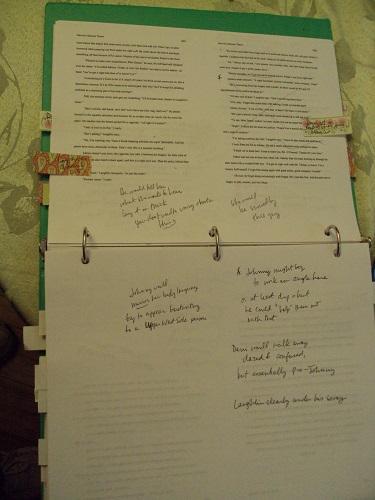
The manuscript printed, two pages per sheet (see example below)

A three-ring binder


A three-hole punch


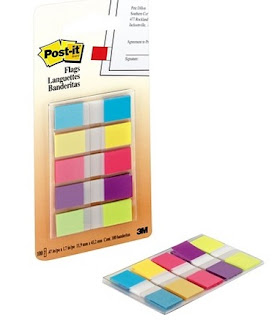
Post-it flags


Flag and list


Prepare your manuscript by hole-punching the pages and inserting them in the binder. I prefer the ring at the bottom of the page, with the back of the previous page as note jotting space. But punching the top would work as well, with note jotting space above.

Assign a colored flag to each of the revision threads you will be tackling. (I happened to have patterned ones, but plain, as shown above, work great too. Color coding is the key.)

Open a new document in Word and list the major threads. This will be where you keep a record of all your concerns, ideas and plans: a revision running list.

I like using the space below to jot notes.
Go through the manuscript, scene by scene. Look for opportunities to add or replace material for each thread.

Flag the scene with the appropriate colored flag. Jot a note in the margin or on the adjacent page about what's bothering you.

In your  running list Word document, under the appropriate thread,

~List the page where you see the opportunity.
~Describe what isn't working.
~Brainstorm possible solutions.
~Jot down dialogue or descriptions that occur to you

If ideas to fix later scenes involving the same thread occur to you as you read earlier scenes, describe them in your running list under the appropriate thread. When you eventually get to those scenes in the read-through, add flags to the pages and page numbers to your running list.

As much as possible, try to tackle this identification process in a linear manner, progressing from the beginning to the end of the story. Otherwise, you risk missing minor details that affect your revision threads and need to be changed.

Resist the urge to actually fix any of the problems. Simply list them. If you have a perfect solution, add it to the running list.

Conversely, if you don't have a solution, there's no pressure. You're aware of the issue and can come back to it later. Perhaps once you've tackled other things, a solution will come to you

Revise your manuscript


Print out your complete running list.

Tackle any revision you clearly know how to fix. Then remove the colored flag from that page in your notebook, and check it off your running list. (I find it helpful to also use strike-through on the electronic version of my running list as a back up, because I may end up adding to the list as I actually do the revisions.)

Move on to the more and  more difficult revisions and rewrites. If any revision will affect a later problem scene, add the information about what changes to your running list.

Continue until you've removed all the flags and crossed off everything on your list.

Print a fresh copy of your story. Set it aside for a few days.

Read through it aloud. Mark rough transitions, voice issues, repetition, echoes, wordiness, and typos.

Make those corrections.

Pass the manuscript off to beta readers or your editor, depending on how confident you feel after your copy-editing read.

How do you typically tackle revisions? 
Wednesday, December 16, 2015 Laurel Garver
Revisions. Love 'em or hate 'em, they're a necessary step to strengthening your work. But it's easy to get really overwhelmed by the prospect of fixing problems, or simply bounce randomly from place to place in the story doing small tweaks without tackling the bigger issues.

Once you have a manuscript that's complete, you can try to identify weaknesses yourself, after you've set the manuscript aside for a while. Or you can ask a few readers to give it a look. I've done both before digging into a full revision.

Your goal is to identify a set of major threads--perhaps character arcs or plots--that need to be shored up or perhaps re-conceived. Between reader feedback and my own re-reading of sections and scenes they identified as somehow lacking, I came up with four major threads. With this knowledge, I next do the following:

Gather supplies


I find it helpful to work with a printed version of my manuscript. It's easier to navigate than an electronic one and I'm less likely to end up with version confusion if I do the messiest marking up on a physical copy. For my method, you need

The manuscript printed, two pages per sheet (see example below)

A three-ring binder


A three-hole punch


Post-it flags


Flag and list


Prepare your manuscript by hole-punching the pages and inserting them in the binder. I prefer the ring at the bottom of the page, with the back of the previous page as note jotting space. But punching the top would work as well, with note jotting space above.

Assign a colored flag to each of the revision threads you will be tackling. (I happened to have patterned ones, but plain, as shown above, work great too. Color coding is the key.)

Open a new document in Word and list the major threads. This will be where you keep a record of all your concerns, ideas and plans: a revision running list.

I like using the space below to jot notes.
Go through the manuscript, scene by scene. Look for opportunities to add or replace material for each thread.

Flag the scene with the appropriate colored flag. Jot a note in the margin or on the adjacent page about what's bothering you.

In your  running list Word document, under the appropriate thread,

~List the page where you see the opportunity.
~Describe what isn't working.
~Brainstorm possible solutions.
~Jot down dialogue or descriptions that occur to you

If ideas to fix later scenes involving the same thread occur to you as you read earlier scenes, describe them in your running list under the appropriate thread. When you eventually get to those scenes in the read-through, add flags to the pages and page numbers to your running list.

As much as possible, try to tackle this identification process in a linear manner, progressing from the beginning to the end of the story. Otherwise, you risk missing minor details that affect your revision threads and need to be changed.

Resist the urge to actually fix any of the problems. Simply list them. If you have a perfect solution, add it to the running list.

Conversely, if you don't have a solution, there's no pressure. You're aware of the issue and can come back to it later. Perhaps once you've tackled other things, a solution will come to you

Revise your manuscript


Print out your complete running list.

Tackle any revision you clearly know how to fix. Then remove the colored flag from that page in your notebook, and check it off your running list. (I find it helpful to also use strike-through on the electronic version of my running list as a back up, because I may end up adding to the list as I actually do the revisions.)

Move on to the more and  more difficult revisions and rewrites. If any revision will affect a later problem scene, add the information about what changes to your running list.

Continue until you've removed all the flags and crossed off everything on your list.

Print a fresh copy of your story. Set it aside for a few days.

Read through it aloud. Mark rough transitions, voice issues, repetition, echoes, wordiness, and typos.

Make those corrections.

Pass the manuscript off to beta readers or your editor, depending on how confident you feel after your copy-editing read.

How do you typically tackle revisions? 

Wednesday, December 9

Melodrama. It might make for addictive daytime TV, but it tends to drive readers crazy.

It's a long, slow ride to the top (Photo by kconnors from morguefile.com)
Consider the following melodramatic scenarios:

  • Eyes lock across a crowded room and the hero will now spend 300 pages risking his life for a woman he has never spoken to.
  • The heroine's boyfriend sees her touch another man's shoulder in a conversation, A page later, he strangles the rival and disembowels him, then sends the organs to the heroine.
  • A knee-replacement patient wobbles during physical therapy and has a crying, screaming, furniture-tossing tantrum.
  • A destitute single mother receives a million-dollar check from a philanthropist she never met.

What do you notice is a common thread among these scenarios?

Suddenness. Instantaneous action. Emotionally going from 0 to 60 m.p.h. in two seconds flat.

In other words, what tends to convert a dramatic moment into a melodramatic one is lack of preparation.

Consider how each of the above scenarios could be converted from melodrama to drama with some preparation.

Scenario 1

Eyes lock across a crowded room and the hero will now spend 300 pages risking his life for a woman he has never spoken to.

~Eyes lock across a crowded room. That woman looks so much like his dead wife, the one he couldn't save. He'll do anything to atone for his failure on that mountainside.

~Eyes lock across a crowded room. That woman looks so much like his missing sister. Could it really be her? He'll do anything to find out, and to keep her safe.

~Eyes lock across a crowded room. He knows she's had nine drinks so far, and he won't let her out of his sight. Not like he did with his college roommate who didn't live to see graduation.

Backstory, parsed out at key moments, can give some preparation for a character's radical actions.

Alternately, you can use nonlinear narration to give us this moment that seems out of the blue, then gradually reveal how this character's reaction is inevitable, based on previous experiences. 

Finally, you can ratchet down the emotion, so it's not no connection to "die for you" in seconds. More on that with the next scenario....

Scenario 2

The heroine's boyfriend sees her touch another man's shoulder in a conversation. A page later, he strangles the rival  and disembowels him, then sends the organs to the heroine.

The heroine's boyfriend sees her touch another man's shoulder in a conversation. That's her brother, right? he thinks. No wait, who is that guy?

He ponders whether she tends to touch shoulders of anyone she converses with. He gathers data, watching her talk to women, children, men old and young. He notes that she rarely touches anyone but him.

He casually brings up the shoulder-touching incident in conversation with her, not mentioning the touch. "Who were you talking to the other day?"

When she gives an innocent spin on the story, he fears she is lying, and presses back. "You seemed awfully friendly."

Her protestation confirms his fear. The lady doth protest too much, as Hamlet's mom says. My girl is definitely lying.

He becomes fixated on learning more about his rival. Is he married or in a relationship? How long has he known my girlfriend? In what capacity? He asks friends' opinions of the rival.  Googles the rival. Stalks his Facebook page. Any data that confirms his suspicions will be worried over, repeatedly rehearsed.

When the heroine will next be put into contact with the rival, her boyfriend  tries to convince her to change plans. When she refuses to do so, his anxiety increases more. He will try to control her appearance, suggesting she wear more modest clothes, less makeup.

He asks a friend to keep tabs on her while she is in contact with the rival, and to call him if anything seems out of line.

While his friend is spying, the boyfriend torments himself. He imagines the heroine in passionate embraces, hotel trysts, a Vegas wedding chapel. He wonders what he did wrong in their relationship that would drive her to cheat. He re-imagines every happy memory they ever had together and looks for signs that she was somehow unhappy or deceptive.

When the friend reports back that he saw the heroine and rival whispering together in a corner, the boyfriend ups his game once again and begins stalking the heroine, the rival, or both.


I can probably pause here, as you likely see where this is going. Jealous rages do not come out of nowhere. They start from a small suspicious action that is misinterpreted and gradually magnified. The jealous one will work every possible angle to either disprove or prove his suspicions, depending on how trusting vs. insecure he is, or how healthy vs. narcissistic.

Likewise, jealous rages do not become homicidal in nature until the one cheated on slowly but inevitably comes to the end of his rope. He will try all kinds of other methods to part the lovers or protect his own feelings before he will resort to murder.

Skipping the long arc of emotional escalation will always feel unrealistic and melodramatic.

Your MUST slow it down. Think escalator, not bullet train. The increase in "height" (intensity) should be gradual. 

Dissect the emotion. Think through how suspicion becomes worry becomes paranoia becomes jealous heat becomes anger becomes rage. 

Too fast emotional escalation is one of the key problems I see in beginning writers. If you want to improve your craft, make it your mission to understand HOW emotions escalate. 

  • Study books and films that do it well and analyze how they did it. 
  • Read psychology books and self-help books that analyze emotion.
  • Observe emotional escalation in those around you and make notes about what you see and hear. 
  • Listen to your inner voice when your emotions are stirred. How does it feel to become gradually more angry, for example, or more hopeful?

Exercise

Take one of the remaining melodramatic scenarios above and consider how to rewrite it either by properly preparing or by slowing down the emotional escalation.


Do you struggle with melodramatic scenes cropping up in your story? How might you better prepare for dramatic actions?

Wednesday, December 09, 2015 Laurel Garver
Melodrama. It might make for addictive daytime TV, but it tends to drive readers crazy.

It's a long, slow ride to the top (Photo by kconnors from morguefile.com)
Consider the following melodramatic scenarios:

  • Eyes lock across a crowded room and the hero will now spend 300 pages risking his life for a woman he has never spoken to.
  • The heroine's boyfriend sees her touch another man's shoulder in a conversation, A page later, he strangles the rival and disembowels him, then sends the organs to the heroine.
  • A knee-replacement patient wobbles during physical therapy and has a crying, screaming, furniture-tossing tantrum.
  • A destitute single mother receives a million-dollar check from a philanthropist she never met.

What do you notice is a common thread among these scenarios?

Suddenness. Instantaneous action. Emotionally going from 0 to 60 m.p.h. in two seconds flat.

In other words, what tends to convert a dramatic moment into a melodramatic one is lack of preparation.

Consider how each of the above scenarios could be converted from melodrama to drama with some preparation.

Scenario 1

Eyes lock across a crowded room and the hero will now spend 300 pages risking his life for a woman he has never spoken to.

~Eyes lock across a crowded room. That woman looks so much like his dead wife, the one he couldn't save. He'll do anything to atone for his failure on that mountainside.

~Eyes lock across a crowded room. That woman looks so much like his missing sister. Could it really be her? He'll do anything to find out, and to keep her safe.

~Eyes lock across a crowded room. He knows she's had nine drinks so far, and he won't let her out of his sight. Not like he did with his college roommate who didn't live to see graduation.

Backstory, parsed out at key moments, can give some preparation for a character's radical actions.

Alternately, you can use nonlinear narration to give us this moment that seems out of the blue, then gradually reveal how this character's reaction is inevitable, based on previous experiences. 

Finally, you can ratchet down the emotion, so it's not no connection to "die for you" in seconds. More on that with the next scenario....

Scenario 2

The heroine's boyfriend sees her touch another man's shoulder in a conversation. A page later, he strangles the rival  and disembowels him, then sends the organs to the heroine.

The heroine's boyfriend sees her touch another man's shoulder in a conversation. That's her brother, right? he thinks. No wait, who is that guy?

He ponders whether she tends to touch shoulders of anyone she converses with. He gathers data, watching her talk to women, children, men old and young. He notes that she rarely touches anyone but him.

He casually brings up the shoulder-touching incident in conversation with her, not mentioning the touch. "Who were you talking to the other day?"

When she gives an innocent spin on the story, he fears she is lying, and presses back. "You seemed awfully friendly."

Her protestation confirms his fear. The lady doth protest too much, as Hamlet's mom says. My girl is definitely lying.

He becomes fixated on learning more about his rival. Is he married or in a relationship? How long has he known my girlfriend? In what capacity? He asks friends' opinions of the rival.  Googles the rival. Stalks his Facebook page. Any data that confirms his suspicions will be worried over, repeatedly rehearsed.

When the heroine will next be put into contact with the rival, her boyfriend  tries to convince her to change plans. When she refuses to do so, his anxiety increases more. He will try to control her appearance, suggesting she wear more modest clothes, less makeup.

He asks a friend to keep tabs on her while she is in contact with the rival, and to call him if anything seems out of line.

While his friend is spying, the boyfriend torments himself. He imagines the heroine in passionate embraces, hotel trysts, a Vegas wedding chapel. He wonders what he did wrong in their relationship that would drive her to cheat. He re-imagines every happy memory they ever had together and looks for signs that she was somehow unhappy or deceptive.

When the friend reports back that he saw the heroine and rival whispering together in a corner, the boyfriend ups his game once again and begins stalking the heroine, the rival, or both.


I can probably pause here, as you likely see where this is going. Jealous rages do not come out of nowhere. They start from a small suspicious action that is misinterpreted and gradually magnified. The jealous one will work every possible angle to either disprove or prove his suspicions, depending on how trusting vs. insecure he is, or how healthy vs. narcissistic.

Likewise, jealous rages do not become homicidal in nature until the one cheated on slowly but inevitably comes to the end of his rope. He will try all kinds of other methods to part the lovers or protect his own feelings before he will resort to murder.

Skipping the long arc of emotional escalation will always feel unrealistic and melodramatic.

Your MUST slow it down. Think escalator, not bullet train. The increase in "height" (intensity) should be gradual. 

Dissect the emotion. Think through how suspicion becomes worry becomes paranoia becomes jealous heat becomes anger becomes rage. 

Too fast emotional escalation is one of the key problems I see in beginning writers. If you want to improve your craft, make it your mission to understand HOW emotions escalate. 

  • Study books and films that do it well and analyze how they did it. 
  • Read psychology books and self-help books that analyze emotion.
  • Observe emotional escalation in those around you and make notes about what you see and hear. 
  • Listen to your inner voice when your emotions are stirred. How does it feel to become gradually more angry, for example, or more hopeful?

Exercise

Take one of the remaining melodramatic scenarios above and consider how to rewrite it either by properly preparing or by slowing down the emotional escalation.


Do you struggle with melodramatic scenes cropping up in your story? How might you better prepare for dramatic actions?

Wednesday, December 2

Photo credit: danielemusella from morguefile.com
December is here, and with it comes a lot of rush and bustle. Shopping, decorating, parties, concerts, recitals, bake sales, visiting family and friends, preparing for visitors, more shopping, more baking, more parties, etc. All the festivities can be pretty draining, not only of your bank account and time, but of your creativity, too.

"Caring for your creativity" might sound a little strange, but think of it like a muscle. It needs both consistent exercise and protection from injury. Holiday busyness provides both unique opportunities and unique dangers for your creative powers.

Deeply engage socially


The times I've been most blocked with my writing have not been for want of time, but want of ideas--specifically interesting stuff for the characters to be doing that move forward their arcs of change. Busy seasons provide an opportunity to fill up with ideas. Getting butt out of chair and living life can help, as can being exceptionally curious and nosy.

During the holidays, you are thrown together with lots of people in all sorts of venues, so take advantage of it. Everyone who crosses your path has an interesting story to share, so make it your mission to access those stories. Some folks will be quick to share their best adventures, others have to warm up a bit. Here are some conversation starters that can help you get people talking:

  • What is your favorite holiday memory?
  • What happened on your worst Christmas ever?
  • What is the most memorable gift you ever received? 
  • What is the kindest thing anyone has done for you?
  • What unique traditions have been passed down in your family?
  • What do you love most about your family? Dislike most?
  • How are you like your parents? How are you different?
  • What was your most precious childhood possession?
  • Are you a collector? What do you collect and why?
  • What is the weirdest secret you ever discovered?
  • What is the funniest thing you’ve ever done?
  • What’s the biggest risk you’ve ever taken? Was it worthwhile?
  • What is the coolest place you’ve ever visited? Scariest? Most disgusting?
  • What mishap turned out better than you ever expected?

Once you ask, listen, not only to story ideas, but also how the story is told. Note the storyteller's tone of voice and be alert to unique turns of phrase. Watch their expressions and gestures. Jot down the best stuff. Get a copy of Emotions in the Wild, a guided journal I created to help you collect data about how real people express emotions, and use it to keep your observations organized.

And if you're a party host, your guests just might love a structured time of storytelling, in which they take turns sharing a funny or touching memory with the group.

Seek pockets of stillness


Busy seasons also have a way of filling our minds with a lot of noise. This can be a big cause of post-holidays burn-out. The more you can give your mind pockets of quiet and stillness, the more mentally healthy you will feel during and after the holidays. Here are some ways to reduce noise and introduce peaceful moments into your day:

  • Pare back on social media. Most of what you'll find there is buy, buy, buy anyway,
  • Set your phone and computer aside more often.
  • Limit TV watching
  • Take far-away parking spaces and walk more
  • Begin and end the day with a few minutes of silent reflection or prayer
  • Journal: write away some of the noise of the day, then write about your childhood
  • Snuggle with pets and loved ones
  • Cook something that has to be constantly stirred
  • Listen to soothing music while doing gentle stretches
  • Walk, preferably during daylight hours to get vitamin D
  • Swap a few showers for baths
  • Copy poems or inspiring prose into your journal
  • Write snail-mail letters to distant friends and family
  • Improvise with a musical instrument
  • Doodle, draw or color
  • Build Legos with or without your family

Balancing out the hustle and bustle with quiet should make for a happier holiday season, and keep burn-out at bay.

What special challenges make writing difficult for you in December? Which ideas above appeal to you most?

Wednesday, December 02, 2015 Laurel Garver
Photo credit: danielemusella from morguefile.com
December is here, and with it comes a lot of rush and bustle. Shopping, decorating, parties, concerts, recitals, bake sales, visiting family and friends, preparing for visitors, more shopping, more baking, more parties, etc. All the festivities can be pretty draining, not only of your bank account and time, but of your creativity, too.

"Caring for your creativity" might sound a little strange, but think of it like a muscle. It needs both consistent exercise and protection from injury. Holiday busyness provides both unique opportunities and unique dangers for your creative powers.

Deeply engage socially


The times I've been most blocked with my writing have not been for want of time, but want of ideas--specifically interesting stuff for the characters to be doing that move forward their arcs of change. Busy seasons provide an opportunity to fill up with ideas. Getting butt out of chair and living life can help, as can being exceptionally curious and nosy.

During the holidays, you are thrown together with lots of people in all sorts of venues, so take advantage of it. Everyone who crosses your path has an interesting story to share, so make it your mission to access those stories. Some folks will be quick to share their best adventures, others have to warm up a bit. Here are some conversation starters that can help you get people talking:

  • What is your favorite holiday memory?
  • What happened on your worst Christmas ever?
  • What is the most memorable gift you ever received? 
  • What is the kindest thing anyone has done for you?
  • What unique traditions have been passed down in your family?
  • What do you love most about your family? Dislike most?
  • How are you like your parents? How are you different?
  • What was your most precious childhood possession?
  • Are you a collector? What do you collect and why?
  • What is the weirdest secret you ever discovered?
  • What is the funniest thing you’ve ever done?
  • What’s the biggest risk you’ve ever taken? Was it worthwhile?
  • What is the coolest place you’ve ever visited? Scariest? Most disgusting?
  • What mishap turned out better than you ever expected?

Once you ask, listen, not only to story ideas, but also how the story is told. Note the storyteller's tone of voice and be alert to unique turns of phrase. Watch their expressions and gestures. Jot down the best stuff. Get a copy of Emotions in the Wild, a guided journal I created to help you collect data about how real people express emotions, and use it to keep your observations organized.

And if you're a party host, your guests just might love a structured time of storytelling, in which they take turns sharing a funny or touching memory with the group.

Seek pockets of stillness


Busy seasons also have a way of filling our minds with a lot of noise. This can be a big cause of post-holidays burn-out. The more you can give your mind pockets of quiet and stillness, the more mentally healthy you will feel during and after the holidays. Here are some ways to reduce noise and introduce peaceful moments into your day:

  • Pare back on social media. Most of what you'll find there is buy, buy, buy anyway,
  • Set your phone and computer aside more often.
  • Limit TV watching
  • Take far-away parking spaces and walk more
  • Begin and end the day with a few minutes of silent reflection or prayer
  • Journal: write away some of the noise of the day, then write about your childhood
  • Snuggle with pets and loved ones
  • Cook something that has to be constantly stirred
  • Listen to soothing music while doing gentle stretches
  • Walk, preferably during daylight hours to get vitamin D
  • Swap a few showers for baths
  • Copy poems or inspiring prose into your journal
  • Write snail-mail letters to distant friends and family
  • Improvise with a musical instrument
  • Doodle, draw or color
  • Build Legos with or without your family

Balancing out the hustle and bustle with quiet should make for a happier holiday season, and keep burn-out at bay.

What special challenges make writing difficult for you in December? Which ideas above appeal to you most?